Page 4 of 5

Embodying YES and NO, a Practice to Start Young

It is my belief that basic horsemanship skills are inextricably linked to taking responsibility for what we do and how we show up in every moment with every horse. Basic “humanship” depends on that same self-awareness and self-responsibility. Learning to successfully communicate with a horse translates into the experiential learning of life skills. Social skills, authenticity, clarity, confidence… students can’t learn these things from books, but they can learn them from horses.

3Horses_9107_6x4

One particularly shy young girl of about 11 or 12 was struggling with how to ask the horse with clarity and authority to move forward and to stop. Because she had come to us in Montebelli stables for riding sessions, we had done our best to help her use her body and her breath to relax and center herself, and to understand how to give direction to the horse with her energy, not with her muscle…

After two sessions, it was apparent that the 500-kilo former racehorse was still calling the shots most of the time while she was riding. For the third session, we decided to do something different. Her mother obliged, as we explained that sometimes a totally different interaction with a horse can help people have breakthroughs in their riding. (It can also help them have breakthroughs in all kinds of areas of their lives.) One interesting fact to note: The girl spoke no Italian and very little English, so her mother had been translating at the stables the whole time. In today’s session, I explained that we wouldn’t need translation, as it was going to be all about body language.

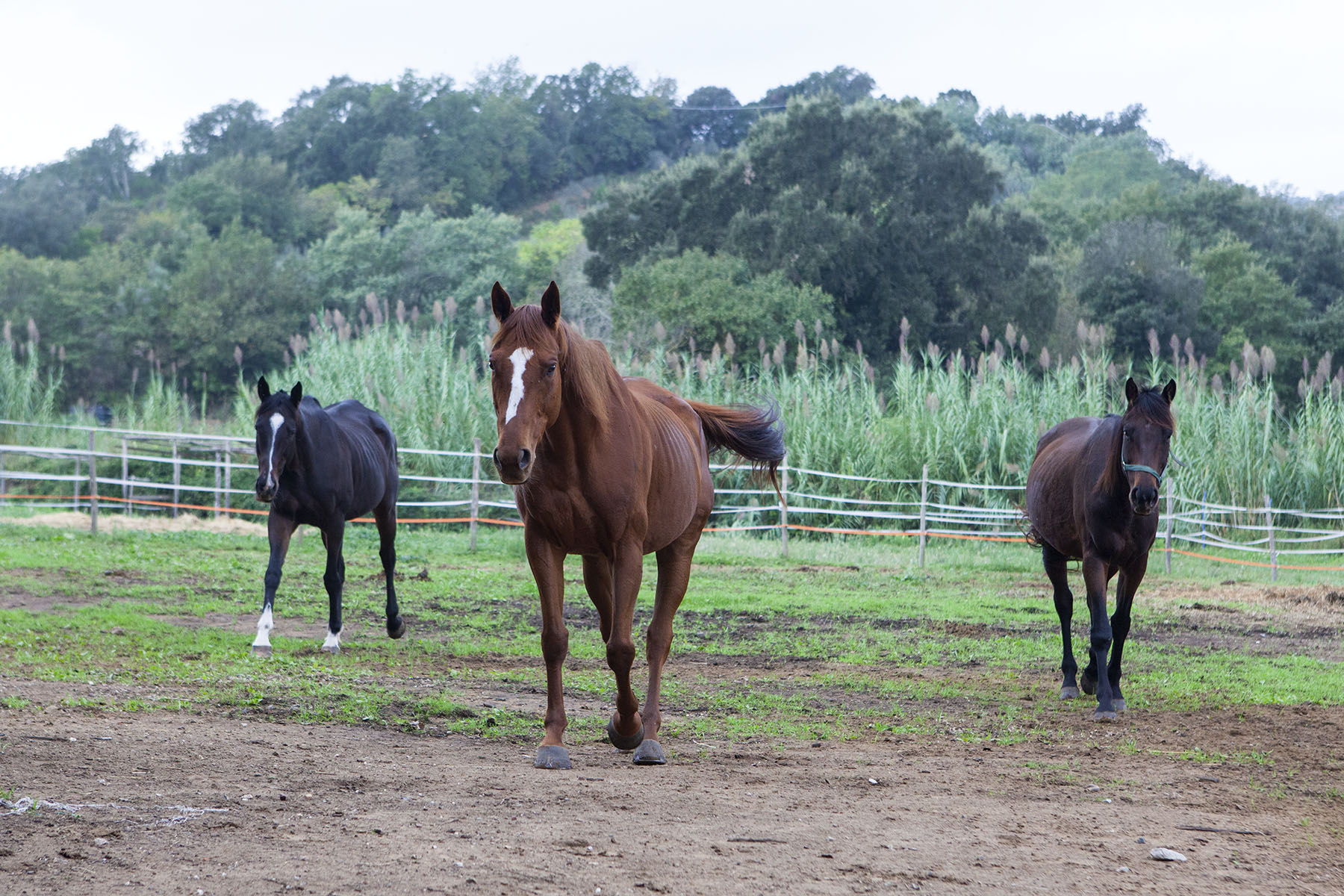
The basic idea was to walk into a paddock with three horses at liberty, and to make ourselves open and inviting enough for them to come to us. At first, she was unsure of the instructions, of herself, of pretty much the whole activity. We spent some very long minutes trying to relax into the unknowingness and the uncertainty she was feeling. When she finally stopped looking back at me to see if she was doing everything right, she began to focus on the horses in the middle of the paddock. Her strides began to take on more weight and conviction. I could see her chest rise and fall with deep breaths, and her arms were slightly raised away from her hips, palms forward.

The horses one by one took notice, at first just pausing between bites of hay. Then they raised their heads. Two horses turned their heads toward her. She stopped and stood, continuing to look to them, holding herself as if she was welcoming them to come to her for a hug. I stood a short distance behind her, allowing her energy to be the focal point as much as possible. In only a few seconds, two horses started walking towards her. The joy on her face was beaming. As they arrived, she began stroking their heads and necks, and they eagerly moved in even closer for more attention. She started to giggle a bit as one horse nudged her torso with his head. In that moment, however, she was taken off balance. Though there was no immediate danger, I reminded her about the practice of staying balanced and centered. She got her feet back evenly and squarely beneath her shoulders, and faced into the horses again.

She continued to say,”Yes, come in!” The horses kept pushing on her. Though she was not distressed, she was concerned, realizing how easily she might be overpowered, and it was time for the lesson to shift. Without any words, I showed her how to make her body like a mountain, and to send her energy from her center, supported by her arms coming up and forward to say “No more!” and the horses immediately backed off. As I backed away, the horses began to turn towards her, and when one horse’s head started to come close in to her body, she practiced one of the strongest “No!” stances I’ve seen. In fact, she continued to back them further away, and they seemed visibly surprised at this radical change. We practiced being inviting, accepting and then setting limits.

We thanked all the horses for their work, and as we walked back toward her mother, I could see that witnessing this experience had brought up some emotion in her. I, too, felt the emotion stirring around the tremendous importance of young girls safely, quickly and obviously learning to embody their boundaries, and learning the power of their own bodies’ energy.

Sylvia Update: No Coincidences

Nearly one year ago, our little mare, Sylvia, survived a severe colic episode, stunning us with her determination and strong spirit. The care and support of colleagues and clients present at Montebelli for one of the Coming Back to Center workshops played a significant role in helping her bear the extreme intestinal pain and to not give up. For more than 24 hours, her life was at stake, and behind every push to keep her on her feet and moving, every massaging hand on her swollen belly, and every tender, connected caress was a powerful energetic commitment to her well being. We work with and teach about the power of energy every day here at Montebelli, and often we focus on the growth, the education and the healing that the energy of the horses brings people. In this case, it was the healing energy of people that helped save Sylvia.

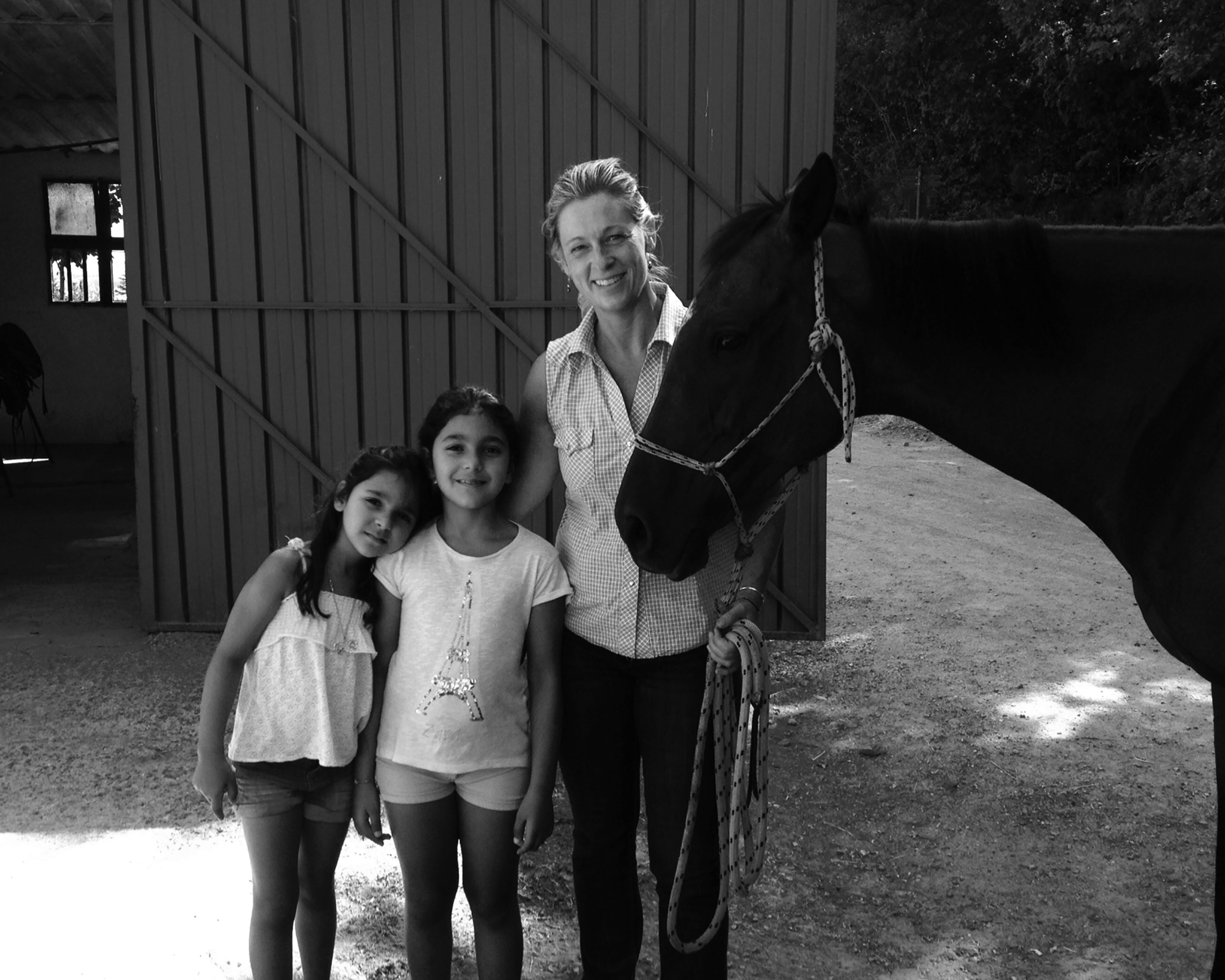
One of the clients present that special day returned this week to Montebelli with her two young daughters. The horse who connected most with the family was Sylvia. She showed each member of the family something significant about their own energy and style, whether at liberty in the arena, moving in the round pen, or riding. She formed a special bond with the elder daughter, who was able to dramatically increase her leadership presence and embody confidence in just three days. It was evident that this seven year old girl from Istanbul possessed the same spirit of determination and fortitude as the eight year old mare from Italy. As we always say, there is no such thing as coincidence.

Ash_Aysh_Mel_Sylvia_BW

A Horse for the Soul

You bite, you kick, you lay your ears back and roll your eyes in a way that I could only dream of doing in order to brandish profound disdain. Some might say you never learned manners. I say you know how to express yourself. It is my duty to learn how to communicate with you, to engage with you in a partnership that satisfies us both.

Is this interaction with a horse so different from a relationship with a human being? We are caustic, recalcitrant and we can gesture disapproval graver than any stated phrase with barely the turn of a head and a look in the eye.

Taj_9251_6x4

We love, we long to love, we think we might love, and we lie down sobbing when we think we might never love again. Horses, by contrast, only know love when it is in the air: in the present moment, admitted or concealed. They also know and feel fear, grief, anger and any other emotion that present moment may hold. Being around a horse shines new light on soulful living.

My earliest definition of what a soul is developed at a very young age… probably five or six years old. It was a fluffy, cloud-like gray thing that was loosely rolled up inside the body of every living thing, and it gave that thing its aliveness. It also had a component of character. I believed there was something about each soul that was the reason for no two people or animals being exactly alike.

There was no doubt in my mind that horses had souls. On the farm where I grew up, the horses were distinct in personality and inclination; they played and fought and took care of one another just like people. In fact, it seemed to me, better than people. Around horses, I never wondered whether or not they liked me or whether I was good enough. Due to the farm’s distance from any neighbors who might have been playmates, I spent more time in the fields with the horses after school and on weekends then I did with other children. I was convinced for several years that I had simply been born into the wrong body; I believed I was a horse, and that underneath my 50 pound, two-legged frame and their 1,000-pound, four-legged frames, was exactly the same fluffy, gray, magical, life-giving soul.

By far, the most pleasantly outstanding aspect of my childhood was growing up with horses. They were my friends, my family, and my inspiration. I wandered freely among them in the fields, munching clover and licking salt blocks, feeling at peace and as one with any group or community as I had ever felt. That first moment when they would lift their heads from busily grazing to acknowledge my arrival might as well have been a moment when crowds cheered for the Queen as she made a public appearance.

Horses warded off loneliness, lack and feeling “less than.” They were good company and even better teachers. The first time I witnessed a foal emerge from a mare, I was completely in awe of the wet, pale grayish, shuddering blob that appeared, and within minutes became a perfect little newborn horse. That was magic. The patience, attention and care that mother demonstrated from those first moments of life defined for me a way of being that I had not been shown anywhere else.

When my family moved to the city, I was eleven years old and completely devastated. I locked myself in my room and did nothing but draw horses for days. That move was my first experience with the agony of loss and the pain of transition. I vowed then that somehow I would be reunited with the horses and I would never forget what they meant to me.

As one does in life in order to survive, I adapted. Although I was able to visit and ride my cousin’s horses for several years, I developed close friendships with classmates, discovered boyfriends, and eventually learned to see the tenderness and devotion my own mother had for my brother and me. Yet every time I so much as saw a photo of a horse, a current of emotion and a yearning surged through me.

The path my life took during the years away from horses led me through music, art, photography, political activism, and eventually to a steady corporate sector job in Human Relations. As I look back, I am grateful that I was willing and able to search for that which I found truly inspiring and meaningful in life. Somewhere along the line, I turned to seeking safety and stability in physical and mental terms only. I convinced myself that marriage, a house with a yard and a spare bedroom, and a climb up the corporate ladder would equate to a fulfilling and joyous life.

Instead of achieving the American trumped up version of nirvana, my life began to feel incontrovertibly awful.

When I had just about lost touch with my soul’s desire entirely, I began having visions of horses. Daydreams and night dreams filled my psyche with the four-legged friends who had been my first community as a child. I would drag my listless body to my office each morning, forcing myself to perform the duties of my job at an advertising company in a large city. There was still a part of me that was escaping into the old back field with the babbling brook, where I would eat clover and paw at the cold water with the horses. I began to think incessantly about a life in which I worked with horses to connect people to whatever it is in the world that makes life worth living.

I had no idea what that life would look like. I knew what horses had done for me to connect me to a sense of comfort and belonging many years ago, and that I was sure there would be a way, with the guidance and generosity of the horses, to bring relationship to the disconnected and to introduce possibility to the demoralized.

Though I was not conscious of it at the time, the horses were saving me once again. I was completely disconnected and nearly hopeless. The horses salvaged my link to my own soul. There is no enduring safety and stability in a one or two-dimensional life where the deep longing of the soul, the calling to embody one’s core values and beliefs, is ignored.

… To read the rest of this story, please visit p. 34 of  March/April 2015 TRUE COWBOY MAGAZINE online.


Sylvia: Strength and Vulnerability

SylviaCloseUp_9142_4x4

Sylvia lay in the dirt in the grips of agonizing pain, her swollen sides heaving with each breath, slowly giving up on her fight to live. An eight-year-old thoroughbred mare, and a former racehorse, she was retired to live and work in the horse experience program at Montebelli. This particular afternoon, just two hours before a group of clients was due to arrive for a session with the horses, Sylvia was colicking. Her intestines were either twisted or so impacted that the blockage was creating unfathomable stomach pain, and in severe cases like hers, 8 out of 10 instances result in death.

The only chance Sylvia had for survival was if we could keep her body moving enough to cause movement through her intestines and to reduce her pain. As cruel as it may have appeared, my partner and I had to force her to continue moving – walking, trotting, cantering – no matter how much she wanted to stop, while intermittently administering pain medication, until she could stop and stand without lying down and giving up. We were used to seeing this horse full of life and energy; she was always one to play games in the paddock, teasing and frolicking with both humans and horses alike. Suddenly she was unrecognizably ill, her spirit largely sapped away by the pain.

For two hours, the three of us ran; my partner, Tommaso, and I each covering one end of a paddock, and as she would slow down, we would chase her and move her on. The other horses ran with her, somehow lending their solidarity and support. All of us were sweating and exhausted, but not enough manure had passed out of her to keep her from continued colic.

When the group of clients from the Coming Back to Center somatic workshop arrived, we had no choice but to abandon the original plan for the afternoon’s exercises with horses. We could not leave this horse. We explained the circumstances and invited the group to observe. While Tommaso continued the constant pressure to keep the mare moving, I talked to the group about the dual nature of horses: at once they are powerful, majestic and creatures embodying strength, and they are creatures for whom a seemingly minor illness or injury can quickly become life threatening. This duality of strength and fragility is a paradox we all live with. All of our gifts and strengths can become challenges and weaknesses when we don’t embrace the 360 degree view of them, honoring the strength and accepting the vulnerability.

Periodically, Tommaso would let up on the pressure, and we would all watch intently as Sylvia would come to a halt, and then lie down. When she lay down and showed clear signs of continued stomach pain and distress, rubbing against the earth or splaying out her neck and head on the ground in resignation, we would have to immediately get her up again, and get her moving. This was excruciating to watch; witnessing her torment and her inability to keep fighting on her own touched the chords in us humans that echoed the pain of grief and the fear of death in our own lives.

As Sylvia would pass by the fence line where the group was standing, many people reached out with their arms to her, and all of them began to reach out with their hearts. There was a clear desire to give support, to assist in some way, to give this horse the additional will she needed to survive. We invited the group to enter the paddock. Nineteen people poured in through the gate, some of them running from where they stood as soon as I opened it. When they were all inside, they stood in a large huddle near the edge of the paddock. Tommaso released the pressure on her from the opposite end of the paddock, and she slowed to a walk. She walked directly toward the large group. She then walked in amongst the group, to the very center – amidst throngs of hands and arms stroking her body, amidst many words of encouragement to her, and amidst many tears springing from familiar, shared pain and struggle.

For the first time that afternoon, Sylvia did not try to lie down. She stood still, soaking in the love, the compassion and the care. People began to speak up and share their personal stories of loss, of illness, of grief, of fear and conflict in the face of the paradox of both fighting to live and accepting death. Horses often bring out the emotions and issues we may be ignoring or avoiding to some extent. Their willingness to connect with us, to respond to us without judgment is a gift that can free us to see parts of ourselves and our lives in a new way.

As the workshop session came to a close, Sylvia’s struggle was far from over. There was still at least an hour more of forced movement, more injections of medication, and then a long night in a stall being monitored. Some participants came to the stables late at night to be with her and to massage her belly. One of Montebelli’s owners spent hours with her in the dark. Tommaso would not leave her until he saw her lie down and get back up again on her own.

By morning we felt like she had a decent chance to make it. The vet came that day, and removed the last of the blockage, which was, fortunately, close enough to the end of the intestine to remove manually. Sylvia was exhausted and her body was flooded with toxins from the impaction, the odor of which was noticeable on her skin. The day after that, Sylvia could barely walk. The soreness from all the exertion was then compounded by abscesses that formed in her front feet. For two more weeks, she hobbled in pain in and out of her stall as we cleaned, disinfected and bandaged her hooves.

Gradually, she began to walk with sure steps again. We had been answering emailed inquiries of concern from the workshop participants throughout her entire recovery. We remained positive, we held out the belief that she would fully recover, but it wasn’t until the morning I released her into the largest paddock and watched her lead four other horses in a full gallop around the perimeter that I could let myself cry for joy.

It is not always possible to save or even help other beings, and those other beings must want to save or help themselves. Sylvia’s desire to save herself had dwindled to being tenuous at best, and what we witnessed in her turnaround and recovery is a testament to the power of conscious energy being given in abundance, as well as readily received by one in need.

Sylvia+Ash

More Than the Mind

It was late afternoon, the sun cast a deep yellow film across the dry hillside. Something compelled me to go check on the horses. I spotted Lottie, the small pinto mare, and right away saw something was wrong. As I approached her, I grew increasingly alarmed, as I noticed large lumps covering her entire body. I ran my hands across her coat and realized the welts were bloody and raw. Fear and panic began to course through my body. I had never seen anything like this. It looked dreadfully painful. She was standing listlessly, her head bowed toward the ground. I could not tell if the bloody lumps were a result of wounds inflicted externally or lesions that had developed from the inside. The extent of her malady was so massive that it was overwhelming. Here was an animal in my care who had somehow developed an extreme, likely lethal, condition and I had no idea when or how it had happened, or what I could do to help her or make it better. I loved this horse. I began to feel dizzy with the alarm and the gravity of the situation.

I do not recall thinking or considering my options. I led the horse to a nearby garbage bin and I placed her gently inside of it and closed the lid.

Some amount of time passed, I do not know what I did to fill that time, but I know that I was not forgetting about Lottie. The pressure of the anxiety over her situation was crushing me. I realized that all I wanted to do was to save her. I thought to myself, “what a stupid way to have dealt with her problem! She is not going to heal in that garbage bin.”

I raced to the bin and opened the lid. She was still alive. She seemed more listless than before, slow to respond, but thankfully, still alive. I eased her out of the bin and stood her up in what was now the cool air of the evening. I began to reconsider my options. What could I do to make her better?


Then I woke up from the dream. My impulse was to run outside and check on Lottie. I recognized that it was only a dream, but I needed to satisfy some part of myself that wanted to be absolutely sure this situation was not real. In the early morning stillness, there Lottie stood with the rest of the herd, halfheartedly swishing her tail at the flies, and raising her head along with the others at the sight of me, anxious for hay.

I did feel a wave of relief in that moment. It wasn’t real. But underneath of that momentary relief was a brewing surge of anxiety. Something about the dream was real. What was it? What did it mean? What did I need to be aware of or look out for?

Lottie_6675


How do I deal with issues and challenges that are enormous, complicated, and new?

What is my body’s first response? How does my mind contribute to trying to find a solution or resolution?

When a dilemma feels really huge, or when I am facing intense confrontation, it consumes my entire body. I feel like my system from my throat down through my gut is being squeezed to the point of unbearable pressure. Often I feel like I will lose bladder control.  If I do not consciously focus on my body becoming grounded, on my breathing staying full and regulated, I leave my body and in that dissociated state, I feel like I have no power, no choice at all.

Next, my mind will begin to clamp down and instead of helping to open up options, it tells me to give up, to run away. My mind reverts to an old recording of attacks against myself, such as, “You are a bad person,” “You are incompetent,” “You are ugly and unlovable,” “You should just give up and die.”

My spirit is not at peace with giving up and dying. I have been in an ongoing cycle of self-defeat and resurrection, thanks to the force of my own spirit and will to go on and try again. The spirit knows there is much to do in this life, and it is the dark horse in this race who keeps coming from behind to prevail, despite a lack of training and nurturing on my part.

For much of my life, I believed my mind. I allowed it to step in and defeat me in the face of battle. Even when I tried to overcome the destructive thinking, it would be another part of my mind that would step in and try to fight. To fight the mind with the mind was not enough.

What I know now is that my spirit is my fuel, my force of will, and my body is a powerful asset. The more I practice using it in new ways in the face of adversity, the more I realize my own strength, competence and beauty as a human animal.


Working with horses allows for daily practice in using the body before the mind. When I need to halter a horse who resists and backs away, I check in with my thoughts. If I entered the stall or the paddock with thoughts like, “I need to take you out to the farrier quickly,” or “My plan is to work with you right now,” chances are that my mind was overrunning my body’s ability to connect with the horse and invite the horse to participate in an activity. No one, including a horse, likes to be told what to do and when without an invitation or established trust.

If I find that I am stuck in my mental mode, I exit and reset my breathing, relax my muscles, and pry open my mind to the fact that my body will be the one doing the work. I can then re-enter, get close to the horse, sync up my breathing, move backwards and forwards with him, relate to his mood and energy level, and invite him into the halter and then the activity.


Acknowledging the success of that practice does not mean I can always succeed in my efforts, it means I ought to keep practicing, always finding new subtleties in the ways in which I can use my own body to both calm myself down and be open to others’ opinions and experiences. If I find myself facing another person who is in some way uncomfortable, frustrated, angry, upset or all of those at once, I ask myself how can I use my body to help keep the mind as well as the emotions from taking control of us both?

To date, I am still quite new at this practice. I find that my habitual mental response jumps in when I am first confronted or when I let myself forget to stay present with my body and I begin to dwell on the issues. I equate that habitual response to being as ineffective as putting a sick or injured horse in a garbage bin to recover. My intent in the dream was not to throw her away, it was the first thing I could think of to do in order to help her heal. The problem is, it was the opposite of helpful and healing, just like the way my mind tries to get me to run away, attack myself, and accept defeat or surrender. That is simply the first thing it can think of, but it is not the only choice. Fortunately, I usually have time to reset my body and mind together, and pull myself out of the bin to try again in a new way.

LottieOnTheHill_5752_4x4

THE VISION BOARD

There I was, back in Seattle in December of 2010, recently certified in Equine Guided Education, with no horses of my own and no idea how I was going to practice this work. I had a new friend, Sue, who was in my certification class at Skyhorse, and she happened to live only 45 minutes from me in Snohomish, Washington. We had met up a couple of times, and done some EGE practice together with her 2 horses, and so she invited me over for New Year’s Eve to make Vision Boards and drink wine. To be honest, the only reason I went was because of the wine. I really did not believe in Vision Boards. I had no idea what to even envision for my life, much less put it on a poster board. But, I figured it couldn’t hurt to cut and paste things out of magazines and chat with Sue and another friend of hers and enjoy a bit of Cabernet.


Perhaps it was something about cutting pictures out of magazines that took me back to my childhood, but there I was, just like when I was a young girl, only choosing the horse magazines and plastering photos of horses all over my board. I didn’t bother to put anything else on there – no farm or barn or romantic beach walk pictures – just horses. I didn’t really think about it at the time, in fact, I left the board at Sue’s place claiming that “I would finish it later,” since there were still a few blank spots on it where I could squeeze in a few more horses.


Well, my Vision Board disappeared behind some bookcase somewhere, never to be seen again – or so I thought.


2011 began without much incident. I was still riding another friend’s horses, and taking care of her farm whenever she went out of town, but that was the extent of horses in my life. I was working full time as a Human Relations Director at a growing production company, and though I daydreamed about leaving and pursuing a career in EGE, or taking people on trail rides, or simply introducing people to horses and allowing them the opportunity to experience a relationship with them, it seemed like worlds away from my reality, and I had no idea how I was going to change that.


Then, in the summer of that year, Sue asked me if I wanted to ride a new little mare she’d bought named Daisy, because she didn’t have time to work with her much. A 4-year old quarter horse with only basic training… I wondered if I’d really be up to the task. Well, she was young and pushy on the ground, but amazingly level-headed under saddle. I must admit, I really fell in love with her a few days later, when a bee landed on her and she threw an absolute fit – the only fit I’d seen from her and I never saw one again… only because I have the very same fear of bees, and if it weren’t for Daisy needing help calming down, I would have run away immediately myself. And so, 3 days a week, I would drive 45 minutes out to ride Daisy, often before going to the office in the morning.


I tried not to love her, but I did. How silly could I be, loving someone else’s horse… that could only lead to a painful good-bye at some point. But I couldn’t help myself. And then, one chilly Saturday morning, Sue met up with me in the aisle of the barn and said, “Ashley, I know you might move to California one day, and I want you to know that I see what a special bond you have with Daisy, and I would never take that away. If you go, Daisy can go with you.” Of course I burst into tears. I was absolutely overwhelmed with gratitude for that gift. I had no idea if I would ever really get to move to California, but I had been wanting to for years. My marriage was falling apart, I was struggling to salvage it, and I knew my husband hated the thought of moving to California. Still, if I ever did go, I would have Daisy.

Daisy_hello_7002_4x4

In November, I returned to Skyhorse Ranch to take the certification course again as an advanced student for continued study. I still wasn’t sure how this work was going to be part of my life, but I had done a couple of workshops that year with Hallie, another student certified in my 2010 class, and I knew I enjoyed it. Hallie, not surprisingly, lived in San Jose, California though – so it was quite a commute for me.

Just before the course, Ariana called Sue to ask if she would be interested in a paint mare who had been left at the ranch. Ariana knew Sue was interested in building a youth program, and this horse had been ridden by young girls.


Sue asked me to assess the horse for her when I went down for the class. I prepared myself, determined to stay professional and objective, and above all, not to like the horse. Now, I do admit that I love horses in general. However, I have also come to know that I connect in a special way with only a few horses. The moment I led Taj out of her stall and her ears perked up, I started to feel that connection. As I was leading her into the arena, one of the other students said, “Oh is that your horse?” and a little 10-year-old girl voice inside me wanted so badly to answer, “YES! Yes it is!” But I maintained my professional distance, and I did not say that. I knew in 5 minutes that this horse wanted attention and direction. I took the lead rope off her and she continued to walk circles and figure eights with me around the arena.


Taj was underweight, had a windsucking habit that had worn down her top front teeth, and a tendency to pin her ears when approached. But there was something in her eye that was kind and curious still. Though I really wished Taj could come to Washington so I could spend time with her, I called Sue and told her, “This horse will need a lot of attention. I don’t think you have the time, you have so much going on.” To this she replied, “Oh! I just gave notice that I am taking a 2 month leave of absence from my job, so if you think she has potential in EGE, then I can take her!”


And so it was that Taj shipped up to Washington a few weeks after I returned from Skyhorse myself. I met the trailer with Sue and walked her up the narrow driveway to her new home myself. I spent hours picking ticks off of her – and showing Sue how to pick ticks, since western Washington does not have any ticks – and grooming her and helping her settle in.


Three days later, while hanging Christmas lights, Sue fell off her roof and broke her back.


Sue has made almost a full recovery, but at the time, she was confined to a lounge chair for weeks, and had months of restricted movement and physical therapy. During this time, she re-evaluated her life, and decided that she needed to re-home Daisy and Taj. And so it was that I suddenly had not one, but two horses of my own.

Ash+Taj+Daisy_BW

>>

It was August, 2012, only a few weeks before I left my home and my dogs and my husband in Seattle to head to California, when Sue came out to the barn where I was boarding Taj and Daisy and she reached into the back of her truck and pulled out a large, white poster board. She said, “I brought something for you.” And she turned it over, and there was my Vision Board of horses.

I now live and work at Skyhorse Ranch, and have added a third horse to my family. I still don’t know where my home is, nor exactly how my career with horses will look, but right now it all looks pretty damn good. I guess I need to give the Vision Board some credit, but a lot of credit also goes to my friends and my horses. Magic is real.

Taj_Roll_5350

RE-ENTRY

Learning as an Advanced Student of EGE

Early November, 2011 was the 1-year anniversary of my initial certification course in Equine Guided Education (EGE). I had returned to Skyhorse ranch in northern California to take the final 2 weeks of the certification program as an advanced student. Completing the 3 week certification program in 2010 was a great start for me in the world of EGE, but I’d discovered throughout the past year that there is so much more to learn and study about one’s self as a practitioner, about non-verbal communication, and especially about how to handle the myriad of different situations that arise with people, horses and the surrounding environment while doing this work, that I wanted to re-engage and further my learning and abilities.

EGE is more than just working with horses to learn about non-verbal communication and develop a deeper self-awareness, though it is certainly valuable for those and other life and work skills. EGE opens the gate to reconnecting with the world as the animal beings that we are, to the innate power and accuracy of our intuition, and to our sense of purpose in life.
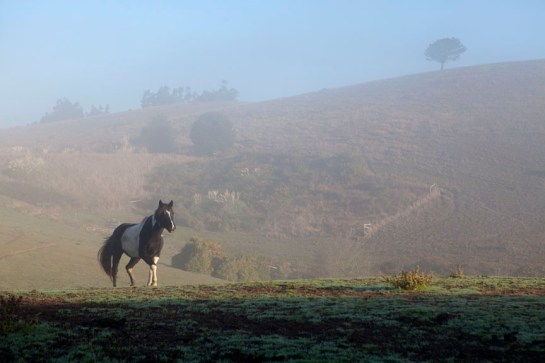
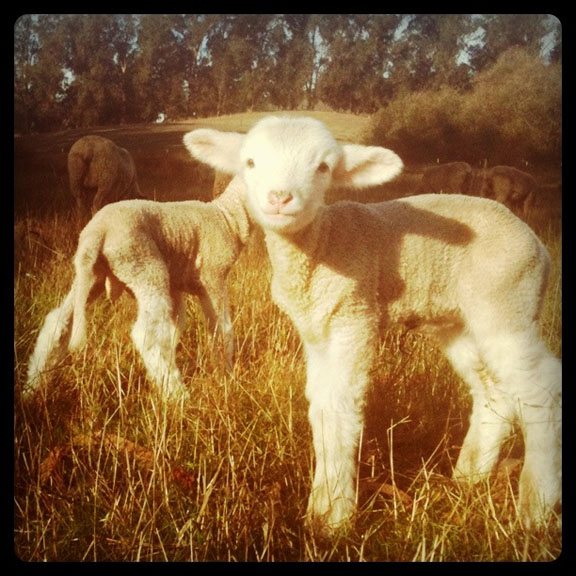
Beyond the intensive work with a group of 9 other students and the herd of horses at Skyhorse, I had the opportunity to build a new bond with my EGE partner, Hallie, who assists on staff at the ranch, and our teacher, and founder of EGE, Ariana. I felt a sense of kinship, of being understood, and of being valued in a whole new way. The animals most directly responsible for getting to the heart of the matter in all of this were actually lambs.

I had a difficult time settling in the first week, as the rest of the class had already been together for a week, and I hadn’t able to take the extra time away from my day job. I wasn’t exactly sure of my role as an ”advanced student,” as I worked to integrate into the class, but felt more comfortable assisting Hallie with barn chores, moving horses and anticipating the needs of the class, the horses and our teacher.

Though it wasn’t available when I first arrived, the guesthouse at the ranch opened up a few days into my stay, so I left the room I was sharing with Hallie, thinking it would be nice to have some more space and to unpack my bag. I went down to the house after class Wednesday night, and it was cavernously empty, dark, and cold, and surrounded on 3 sides by the sheep pasture, which was filled with the relentless and unapologetic reality that is lambing season.
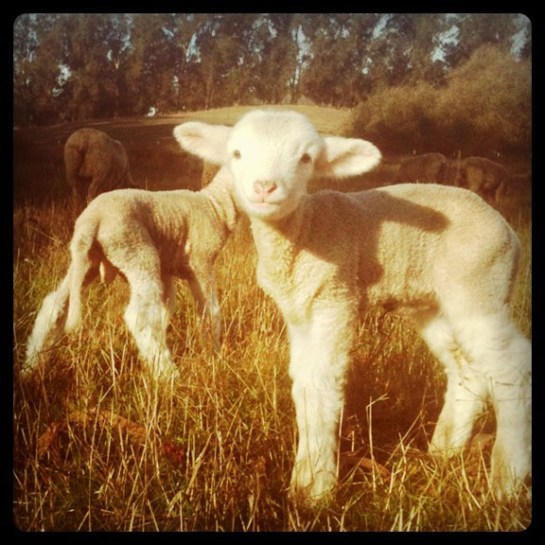
Ewes very often have two lambs, and frequently, within the first 4 days of life, one lamb dies. The vultures hang out hungrily on the fence posts listening to the bleating of the new little beings who have lost their mothers, who may not be strong enough to keep up, or who may have simply been abandoned. This was a sound for which I was not prepared.

After a painfully fitful sleep, I awoke to the frantic maa-maa-ing of a tiny lamb, his dangling umbilical cord still fresh, as close to my front door as he could get in his pasture. No other lambs or ewes were nearby. He was calling out with all his might. I stood there in my nightclothes, tears welling up in my eyes, when I suddenly heard his mother baa-baa-ing from the other side of the house. They were trying to find each other, but couldn’t figure out how to go back around the house to reconnect.

With zero sheep experience, and no clue how dogs can get the job done, I ran out to try to herd that ewe back around to her baby. She was definitely being herded, but never in the right direction. I wasn’t fast enough to get around to the side of her and keep her on track, so she kept shooting off in all directions except the one towards the crying baby. Finally, I figured I would need to bring the lamb to her.

I’ve read that sheep can recognize at least 50 different faces, up to 10 of them human, but I’m not sure I have that skill for recognizing sheep faces. I tried to keep one eye on her while I approached the scared little one. Of course I scared him even more and he tried madly to escape me while I reassured him that I wouldn’t hurt him, tried cajoling him into trusting me, and ultimately, dove in to swoop him up in my arms.

Not entirely sure I had the right ewe, I approached slowly with the little guy, who was now silent, probably somewhat stunned. I placed him on his feet near the presumed mother, who was eyeing me silently along with 2 of her friends and their lambs. Well, the lamb took off like a wobbly rocket towards her and as they all moved away together, I was left panting in my pajamas, hoping for a fairy-tale ending for him.

As for me, there was no way I was going to live there for the next week an a half, alone in the furniture-less house surrounded by sheep strife and struggle, separated from my own herd about a mile up the hill. I realized that unpacking my bag was low priority compared to being close to companions and colleagues. Another room in the ranch house freed up, so I moved in there, relieved and, I thought, ready for anything with my herd around me.

Part of the EGE process includes identifying experiences and stories we have created about those experiences that are shaping our patterns of behavior, our actions and our reactions to the world. One thing that surfaced for me that I hadn’t shared much, if at all, before was the fact that as a child, I truly believed I had been born into the wrong body, that I was a horse trapped in a girl’s form, and that I had rejected my physical body ever since. All my games on the farm where I spent my childhood years featured me being a horse, running, jumping, and playing with the other horses. I ate oats (sweet oats with molasses were my favorite), shared the salt licks in the fields, and even drank water out of an algae-lined bathtub watering trough. When my parents moved us to the city, I shut myself away in my room for days, and when I came out, I found I was every bit as good at pretending to be a well-adjusted, popular, good student and all-around good girl as I had been at pretending to be a horse. But where did all the pretending end? Had it?

Another significant realization was that, throughout my life, integrating and accepting death, be it the death of a barn kitten or the death of my mother, has been extremely challenging for me. Cerebrally, I understand that it happens to every living being. At my core, I had never experienced death in a way that made sense or felt natural or complete. One thing I feel strongly about is that every death deserves an honoring of the life that came before it, and when I don’t feel I’ve truly had the opportunity to fully and ceremoniously honor that life, it haunts me, and gnaws at my heart.

That gnawing, it appears, had become an impetus for a lifelong penchant for rescuing – an ill-advised attempt to help others evade death, strife, or pain of any kind. I used to rescue bugs out of my great-granny’s swimming pool with my cousin, lining them up in the sun-warmed recovery ward that was the diving board. I tried to nurse a sick pigeon back to health in the abandoned dairy section of the barn. When the bird disappeared after 2 days, I assured myself that my care and feeding had given him a new lease on life. Looking back, I’m fairly certain the barn cats mistook that bird for a generously offered feast, but perhaps a new lease in death is something my 8-year-old mind wasn’t yet prepared to ponder.

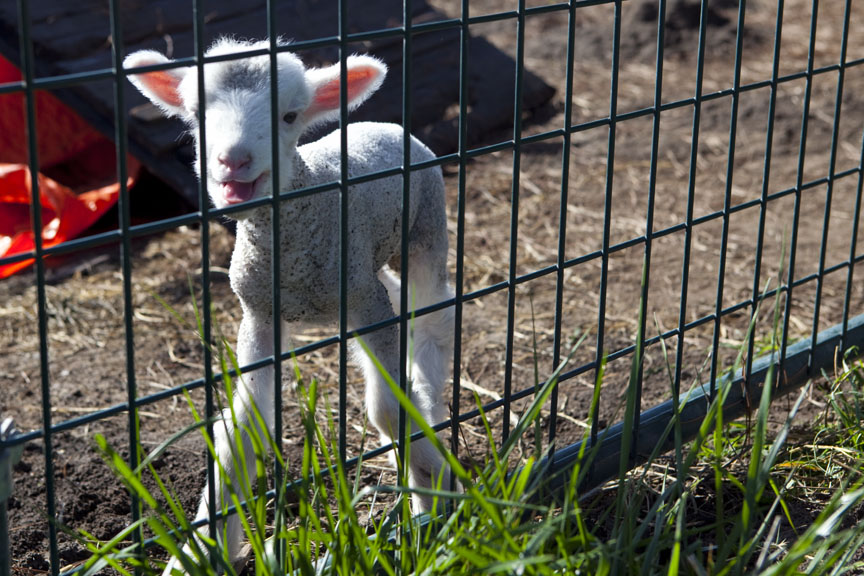
As it happened, during the last week of my stay at the ranch, I became the primary caregiver for orphaned lambs. Ariana brought the first orphan up to live in the pen in front of the house on Monday. After briefly observing formula preparation and bottle-feeding, I embraced my new charge and became the surrogate mother.
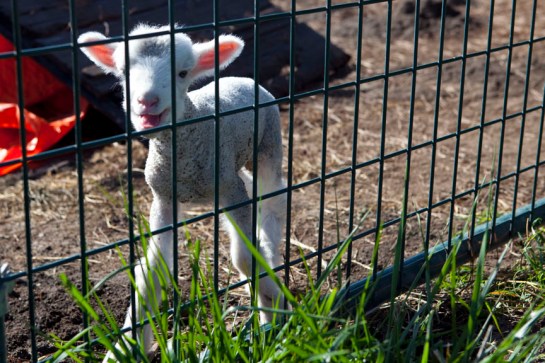
Unlike the lost lamb in the field who tried to run from me, this lamb almost instantly bonded to me, trying to attach himself to my legs and follow me out of the pen, bleating mercilessly when I left him after a feeding, and maa-maa-ing so loudly when he awoke hungry from a nap that I could hear him from the barn a few hundred yards away

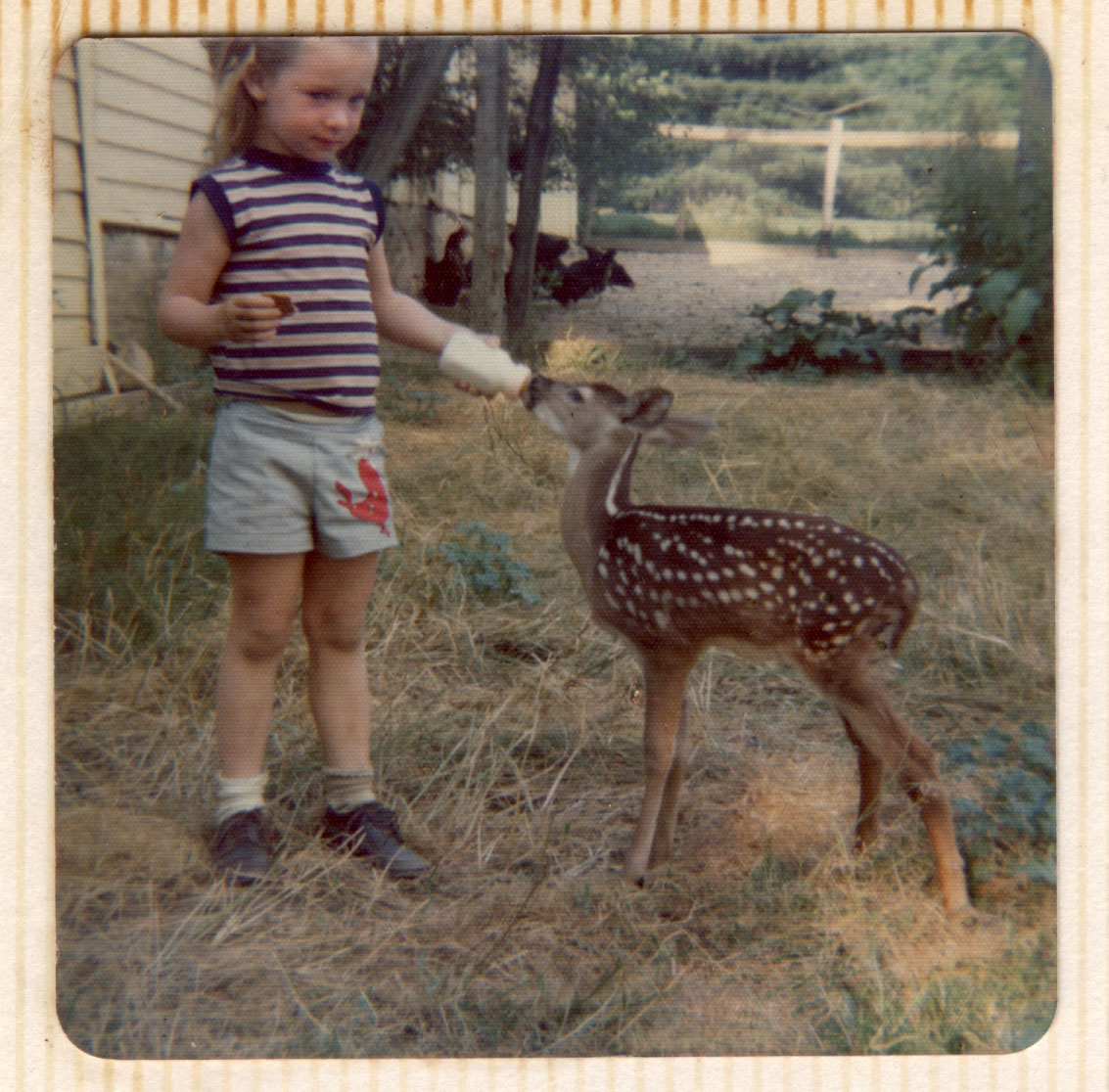
My resume of bottle-feeding began at the age of 5 when my father brought home a fawn from the alfalfa field, badly injured by the sickle bar during harvest. He held the fawn’s trembling body in a blood-stained sheet, his tiny hip sliced through to the bone, and I remember being vehemently angry at the sickle bar, angry at the alfalfa, and angry at my father for what had happened to that animal. I was afraid he was going to be “destroyed,” just like the racehorses who broke their legs on the track. But the care with which my father was handling him meant something important to me.

The equine vet came out to the farm on that Sunday evening, and sewed that hip up in a horse stall on a bed of straw. I named him Flag, after the fawn in “The Yearling,” and helped with his bottle feedings. He grew up in the chicken coop, running after me like a puppy, and following me into the house when he was allowed – jumping on beds, nibbling ears and winning hearts left and right.


The second day into caring for this orphaned lamb, Ariana brought up another unlucky orphan from the sheep field. No matter how hard she had tried to get the mother to accept her newborn and let him nurse, the ewe kept walking away. There were those old feelings again: I was angry at the ewe, angry at the field and angry at the universe for making the way of things so hard to bear.

With my newly acquired skills, I set about regular feedings 3 times a day for the 2 lambs. While one nursed the bottle, the other would latch onto my jacket, inspired and hungry. The new addition was even smaller than the first guy, but seemed every bit as eager to live.

I didn’t name them, because I didn’t want to get attached. But of course I was attached. The instant I held each of them close and supported their little bodies while they struggled to figure out the artificial nipple, I was attached. I finally started calling the older one Day 3 and the younger one Day 2, figuring I’d rename them each subsequent day and make a handy reference to the chart on the formula bucket as they aged and required more food.

But by the afternoon of the second day, Day 2 showed a sudden change in his energy. He still ate, but tired easily while feeding and didn’t maa-maa with the same force and volume. After his night feeding, he immediately lay down under the lean-to shelter instead of scrambling with Day 3 to get out the gate, glued to my legs.

In the morning, I went out to check on them before mixing up the formula, knowing that I may only need to mix half as much. When only one little voice called out to me, I knew I’d lost the little guy. Knowing that didn’t help ease the blow of walking over to see his still body laid out on the ground, with the living lamb still trying to snuggle up to him for warmth. Why does a death feel so painfully unbearable? I’d known that lamb for a day and a half, only a few hours less than his entire life span. I tried to take solace in the fact that I’d fed him and I’d loved him like a mother.

I wrapped his tiny body in a towel and put him in the garage until I would have an opportunity to bury him. I then set about making breakfast for the lamb with an increasingly urgent voice and appetite.

That day was a “Client Day” at the ranch. As students of EGE, part of our program was to plan, host and lead a full day of activities, open to the public, as an introduction to the work. I had to focus all my attention on the clients and the goals of the day, so I put my grief on hold and immersed myself in getting to know the clients, and working together with the horses and my classmates to create an outstanding day of experiential learning.

The opportunity to bury the lamb came at midday the following day. It was Friday, the last day of our EGE course, and I could no longer stave off the feelings of unresolved grief. I don’t remember ever burying anything, except my paternal grandfather when I attended his funeral in Arlington National Cemetery at the age of 7. Every other being I have lost was shepherded away by the adults around, or buried at a time or place I was unable to attend, or cremated. Scattering ashes or setting an urn of ashes in a mausoleum has its own brand of ceremony, but the physical act of digging a hole in the ground and laying a body to rest is something very different to me.

The burial site was adjacent to the pen in which he had spent his short life. As I struggled to make the hole sufficiently deep and wide, the living lamb anxiously bleated and tried to clamor through the wire fence to be next to me. Twice I had to stop digging and go into his pen to untangle him from where he’d gotten himself stuck in the boards of an old gate, propped up in the corner. I was struck by the tremendously divided feelings of focusing on the life that was lost and the life that was fighting to continue.

I spoke to the living lamb about the fact that I would be there for him and feed him soon. When I finally placed the body of the dead lamb in the ground, I spoke to him about the fact that I would be there for him even as he was entering a place I didn’t know or understand.

Tears began to flow as I piled the dirt on top of his body, entombing him in fresh earth, while the living lamb continued to maa-maa a few feet away. My body was wracked with a full-fledged, all-out cry as I patted down the last shovelfuls of dirt on top of the small grave. I was burying this lamb to give him the respectful send-off he deserved, but I realized that I was burying him for all the other beings I didn’t get to bury. Beyond the physical burial act, there was the true acceptance of their passing that I had never quite been able to manage. I thought I had accepted at least some of the deaths, but in that moment, they all came flooding back to me. The lives that were intertwined with mine, whether for only a few minutes or for 28 years; the lives I had wanted to honor upon their deaths but hadn’t known how.

I stood on top of his grave and looked into the gentle wind. I let myself stand between the living and the dead, speaking to them both at once, letting them know how much I loved and appreciated my time with them. I stood there in my body, my animal body, which speaks to all other animals in a way that I had almost forgotten.

When the conversation was finished, I went and got the old gate from the lamb’s pen, and laid it out over the grave.

Rescue for Slaughter-Bound Horses

In March of this year, I helped rescue a horse for the first time. I didn’t have a farm, I didn’t have a trailer, and I never even saw the horse in person. I was able to help by donating online, and by coordinating getting the funds to a foster “mom” who went to pick him up and get him started in his new life. His name is Trooper, a stout and friendly chestnut gelding about 18 years old, and I feel bonded to this day to the people who participated in the joint effort to get him safely into foster care with quarantine and then placement to a new home at a riding camp for children.

Trooper had been sold for likely very little by his former owner to a feedlot owner in Zillah, Washington. It’s unfortunate but all too common that when hard financial times fall on horse owners, the owners don’t have many options. Feedlots and auctions are options, but the real business of these options is not necessarily widely known or understood.

Feedlot owners advertise that they “buy, sell and trade” horses. That is true. That is their business. But because a thriving business exists in the sale of horse meat for human consumption, at the end of almost every week, all the horses left on the lot will be loaded into large stock trailers and shipped across the border to either Canada or Mexico to slaughter houses.

The people who purchase horses to sell for meat are called “kill buyers,” and they work on contracts with slaughter houses  which require them to provide a certain quantity in weight of horse meat to them in a given amount of time. Feedlot owners are guaranteed to receive a certain price per pound for their horses. They will offer the horses for sale to the public for a slightly higher, non-negotiable price, which covers the costs of the extra efforts to coordinate with individual buyers. These prices are usually under $1000, which is not relatively expensive for a horse.


The horses’ breeds, ages and levels of training vary widely.


There are many wonderful horses available, and it is well worth considering rescue as an option for acquiring your next horse. This option means that you will have to make a relatively quick decision, and be prepared for appropriate vet check bills and behavioral quirks that a brief assessment by an experienced rider may not uncover. It is highly recommended that you keep a rescue horse quarantined for the first month, just in case they have picked up strangles or any other contagious infection or illness.

Since March, I have been exploring ways to help publicize this process and get the facts out to people who are interested. Horse slaughter is a controversial and emotional issue. My personal opinion is that, to date, no form of killing en masse in a slaughter house has ever been humane for horses. Simply banning slaughter in the USA has not been enough. We are beginning to see laws passed around humane transport to slaughter, but that is not enough either.

I will do my best to provide links to websites and articles that provide current information, as I believe that the more awareness and involvement we can inspire, the better chance we have of shifting the paradigm and finding better alternatives for horses and horse owners in need. You don’t need to have a farm or a trailer to get involved and make a difference in our horses’ lives. Below are a couple of links that are just a start.


Information regarding the practice and methodology of slaughter can be found at the below link. Some material is graphic, and the author’s bias is very evident, but it is hard to find such a comprehensive explanation without a bias. http://www.respect4horses.com/truth.html

Dr. Temple Grandin, who was reportedly working in Wyoming on researching a more humane form of horse slaughter, determined that the key to solutions lies in (1) stop the overbreeding, (2) find ways to care for horses in need. http://www.animallawcoalition.com/horse-slaughter/article/1491


WASHINGTON RESCUE GROUPS:

People Helping Horses

Rebels Equine Feedlot Savers

And on Facebook, visit Another Sunrise Equine Fundraising Network to follow and contribute to the fundraising efforts for some of the horses that may be posted on my Horse Rescue Network Page.

Catharsis: Inside the Round Pen

The sun seared my tear stained face, my mouth sticky in its coat of dust, my body exhausted to near numbness, and still the big bay horse roared at me, insisting I was not yet finished, I had not gotten all the way through the heart of the matter.

I had been in the round pen with him for well over an hour, dredging up grief, strife, fear and every angle of inner turmoil I could ever have imagined. Still, he was not releasing me.

I had almost called it off. My good friend and EGE facilitator, Hallie, had brought me out to the horses this afternoon to further explore some personal issues we’d been discussing, but I had a flight to catch in about 2 hours and the horse I chose to work with had bolted just before we reached the round pen and run all the way back to his paddock. One thing about Hallie: she is the most calmly determined person I know. I’m not sure if she said anything in words at all, but somehow my attempt to bow out, or at least bow out of working with Buddy, had led to the three of us turning right around and trekking back out to the round pen.

Buddy. The irony of his name revealed itself in the first 5 minutes of entering the round pen with him. The steady, centered horse I’d met napping in the warm California dust became a frenzy of flying hooves, mane and tail, with 1200 pounds of excited, if not panicked, heart and muscle in between. The urgency of his cries ripped through me and I was suddenly swept into a state of interconnectedness with a horse like I had never known. This angst, this pain that he was writhing in and screaming about was my own.

The gift of a round pen experience is the time and space to find your own clarity. An honest, non-judgmental horse reflects what is really going on inside of you, and an impartial, supportive facilitator helps you recognize the relevance of the body language of the horse and anything else in the environment that transpires to lead you into self-awareness and understanding. The challenge is, in order to fully receive that gift, you must let go of your logic, your linear thinking, your ego, and any shred of self-consciousness that holds you hostage to what you “should” be thinking or doing. You are there to bare your soul, and to experience the freedom that comes with doing that.

I had been through the wringer already by the time my flight was taking off at 3:42, some 25 miles away. I need to stop taking responsibility for others and their feelings. Heck, I need to stop thinking I know what their feelings are going to be. I need to start loving and caring for myself, for if I don’t, how will all that I want to do in this world ever happen? Each time I recognized one of these issues, Buddy would stop bellowing, he would stop careening around the pen, sending our adrenaline levels skyward, and he would either defecate, or urinate, or sigh deeply and relax. But when Hallie would ask him if we were finished, he would start up again.

Buddy would belt out an explosive call, sometimes inciting response whinnies from his herd in the distance. He would rush to the fence of the round pen, and press his neck and chest into it, bowing it outward, striking at the lower boards with his hooves. I would be again reduced to tears, wanting to end the pain and frustration, for him, for me, for us both. So I would search for the relevance in the moment, allowing whatever was emerging to surface, then speak the truth of it out loud. Sometimes I spoke to him, sometimes to myself, sometimes to the world at large.

I explored my fragile marriage, a strained friendship, my mother’s death and her belongings in my garage I haven’t been able to throw away. I admitted that I was angry with myself for having anxiety over missing my flight, but that I couldn’t get rid of the pressure to make the flight. I finally resigned myself to miss the flight, to give myself the opportunity to complete this experience, no matter how long it took, since Hallie was not going anywhere, and Buddy was unrelenting. I felt a deep gratitude that these two beings cared enough about me that they didn’t care how long it took.

In one of those moments in which I had spoken up about something that needed acknowledgement, and Buddy had calmed down and begun grazing through the fence boards, I had the urge to ask him to follow me around the round pen, to walk with me in my declaration that I matter, that I am important. But I was afraid to try. I was afraid that he wouldn’t believe me, that I didn’t believe myself, and that he would not follow. I wanted to lead, but I was afraid of failure.

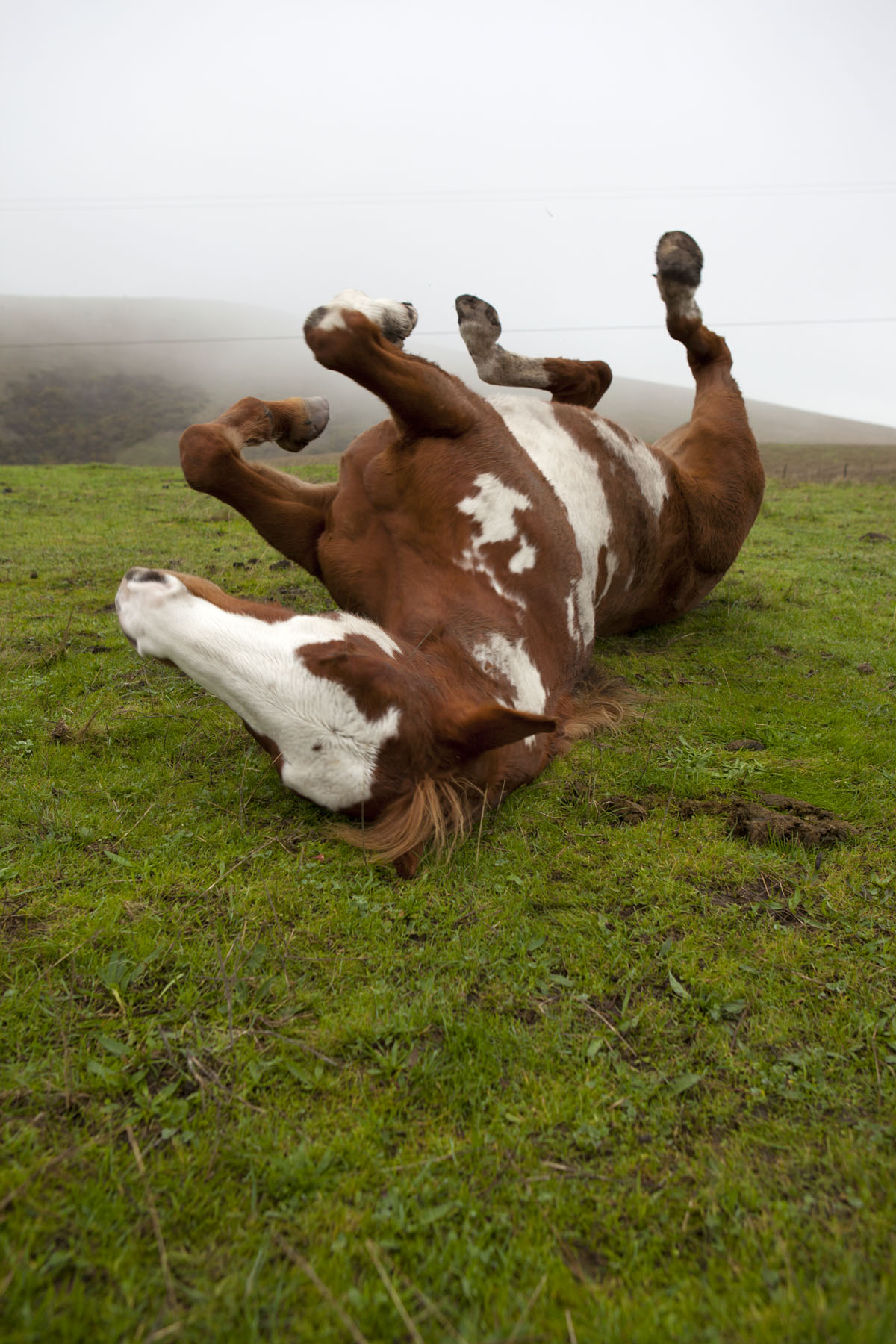
And so it continued. At one point, in the scorching July heat, I knelt down in the middle of the round pen and just cried. I didn’t have any room for self consciousness left; I didn’t have the energy to fight it. So I let myself sit there and bawl. And that big, beautiful horse strode over to me, lay down in the dirt, and rolled. He rolled with luxurious abandon, as if to say, “Let it go, let it out, do whatever you need to do.”

So there we still were, what seemed like, and probably was, hours later… in a moment of calm, which seemed to indicate that we had brought up enough pain, and discovered enough truth, and that we could relax and be finished. Suddenly, gunshots pierced the hazy, hot quiet. Buddy was off and at it again, hollering, calling out in as urgent a voice as ever. “But this can’t be about ME,” I pleaded to Hallie. “These are some gunshots, and yeah I have anxiety over the fact that some killing might be going on, and he’s upset too, but that’s not part of my relevant issue!”

“Well,” she said calmly, “None of the other horses in the paddocks are acting like this.” DAMN IT! She had a point. This was still something to do with me. “What do you feel like this is about?” she asked.

I felt like it was a test. I felt like I had come through all kinds of crap and cried and ached and been downright miserable, but that I had finally reached a place of calm and centeredness, and now this was happening to challenge me to bring myself and this horse back to peace. He was criss-crossing the round pen, rushing through the center, inches from wherever I was standing, so that I could not stand still, I had to turn and shift and maintain presence, or be run over by a very frustrated, very anxious, and very large animal.

I thought about the last issue we had uncovered: needing to accept my imperfections and vulnerabilities. It was as if I hadn’t ever accepted that I was human – an animal with a body who is subject to defecating and urinating and needs and fear and trauma and death and mistakes. I accepted that in everyone else, but not in myself. If Buddy was scared or vulnerable or did something “wrong,” would I still love and respect him? No question.

He’d seen me naked: every weakness, every regret, every conflicted corner of my psyche. But he had never stopped pausing to acknowledge me; to touch his muzzle to my face when I stood next to him at the fence, or to turn from the far side of the ring to look at me in the moments he stood still. He still trusted in me, that I would figure it out, that I would know what to do.

I have always found relief and release in just walking, and suddenly I knew that was the way through this. I wanted him to know that I could take care of myself, and that in doing so, I would take care of him.

“I can lead through this.” That was my silent declaration. And with no halter and no rope, I went to this horse who had been charging across the round pen, and I asked him to follow me.  There was no worrying about whether I would succeed or fail, only the conviction that I knew we could get through this.

I couldn’t see the horse behind me, but I could sure feel him. I felt his every solid step and his head bobbing slightly with the quick and steady pace around the whole perimeter and then back to Hallie at the gate.

Experiential Learning

When we set out to educate ourselves about something, the goal is to remember what we learn for the long haul. How many times have you thought to yourself, “If only I could download that information into my brain…?”

Horses can help with that download. Learning through an experience with a 1300 pound, living, breathing, responsive being gets about as much of you involved in downloading information to long term memory and understanding as possible.

Notice how we are taught to take notes when listening to a lecture, or break out the highlighter marker when reading a textbook. These simple activities move us farther into the experience of absorbing the information. The more of ourselves that we can involve in learning, the longer we can retain the information. Inspiring all of our senses and involving our whole bodies in the process of learning is an advantage that traditional classroom teaching and even the most elaborate of corporate seminars with PowerPoint presentations and props cannot deliver.

Marcia Conner, on her Ageless Learner site, writes a concise but comprehensive description of experiential learning, and quotes author David Kolb from his book Experiential Learning, as he “describes learning as a four-step process. He identifies the steps as (1) watching and (2) thinking (mind), (3) feeling (emotion), and (4) doing (muscle).”

From the world of childhood through the corporate world, the experience of learning self-awareness, presence, trust and decisiveness is an ongoing process. The growing field of Equine Guided Education is offering immediate and lasting results.

Just outside Melbourne, Kay Ivanac and Sally Brinkworth founded EGE Australia, and are not only providing valuable lessons in leadership and teamwork to people of all ages, but are also fulfilling their mission to grow the industry and help support the existence of Australia’s nearly quarter million horses.

Aptly named “Horsepower,” EGEA’s programs exemplify the profound and valuable aspects of learning your strengths and weaknesses in communication and relationships, both personally and professionally. The EGEA website is a rich resource in describing the work and its potential benefits: http://www.equineguidededucation.com.au/