Being a Friend First

When it’s cold and the sky is spitting a nasty blend of rain and snow down on you, and you are excited to come out and see a horse anyway… that is where the magic starts.

Juno came to the farm in mid-December, when his recently acquired safe home fell through and the person who wanted the best for him trusted me to offer him a good life. Being plucked from all that is familiar and taken away from the friends and family you know isn’t easy on anyone, and Juno was no exception – but he was impressively open to trusting new people from the start. It has been imperative for us not to break that trust – to be slow and patient, to begin every new relationship and activity with sacred introduction, and no matter what he may have been like or done in the past, we have made choices based on how he feels and responds each moment, as opposed to acting on assumptions or expectations.

Equine Guided Education and Coaching is a way of working with horses to teach and coach people… and the same way that every session helps me learn and grow as a person while I facilitate, it can also benefit the horses and enrich their lives. Beyond giving them the opportunity to express their opinions, and giving them a job that is not competitive or physically demanding, this work can be done in a way that helps horses heal from past trauma or anxiety much the same way it can help people.

Fortunately for me, and for Juno, we have amazing people who come to us, like this girl we’ll call Kate. From her first time meeting Juno, she has been open-hearted, present and thoughtful. Our goal in working together has been to give Kate a safe place to open up about anything she’s challenged by in her life, to help understand and regulate emotion as it inevitably flows into what we are doing with a horse as well as life elsewhere, and to build her confidence and presence through learning to care for, communicate with, and do basic activities with horses.
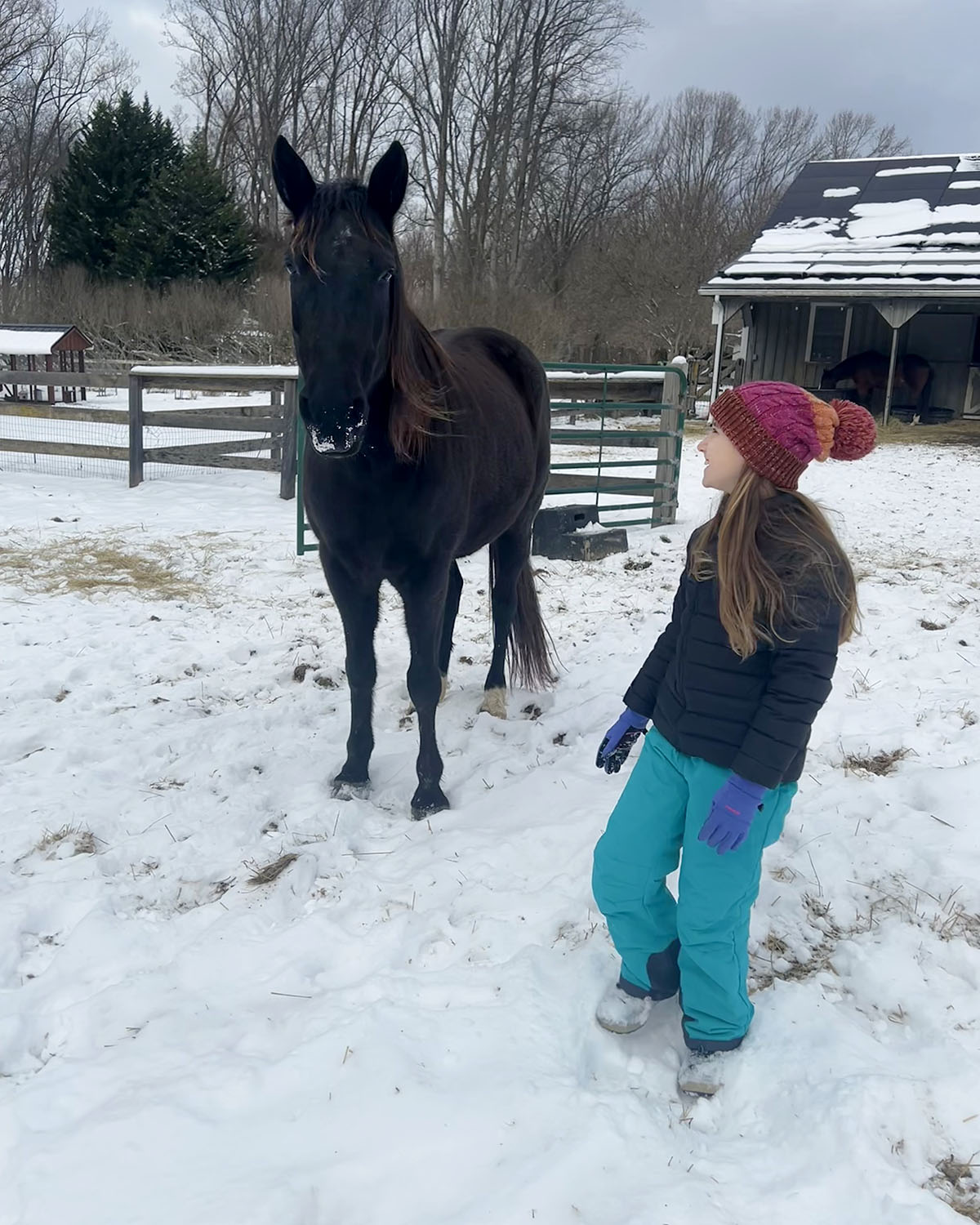
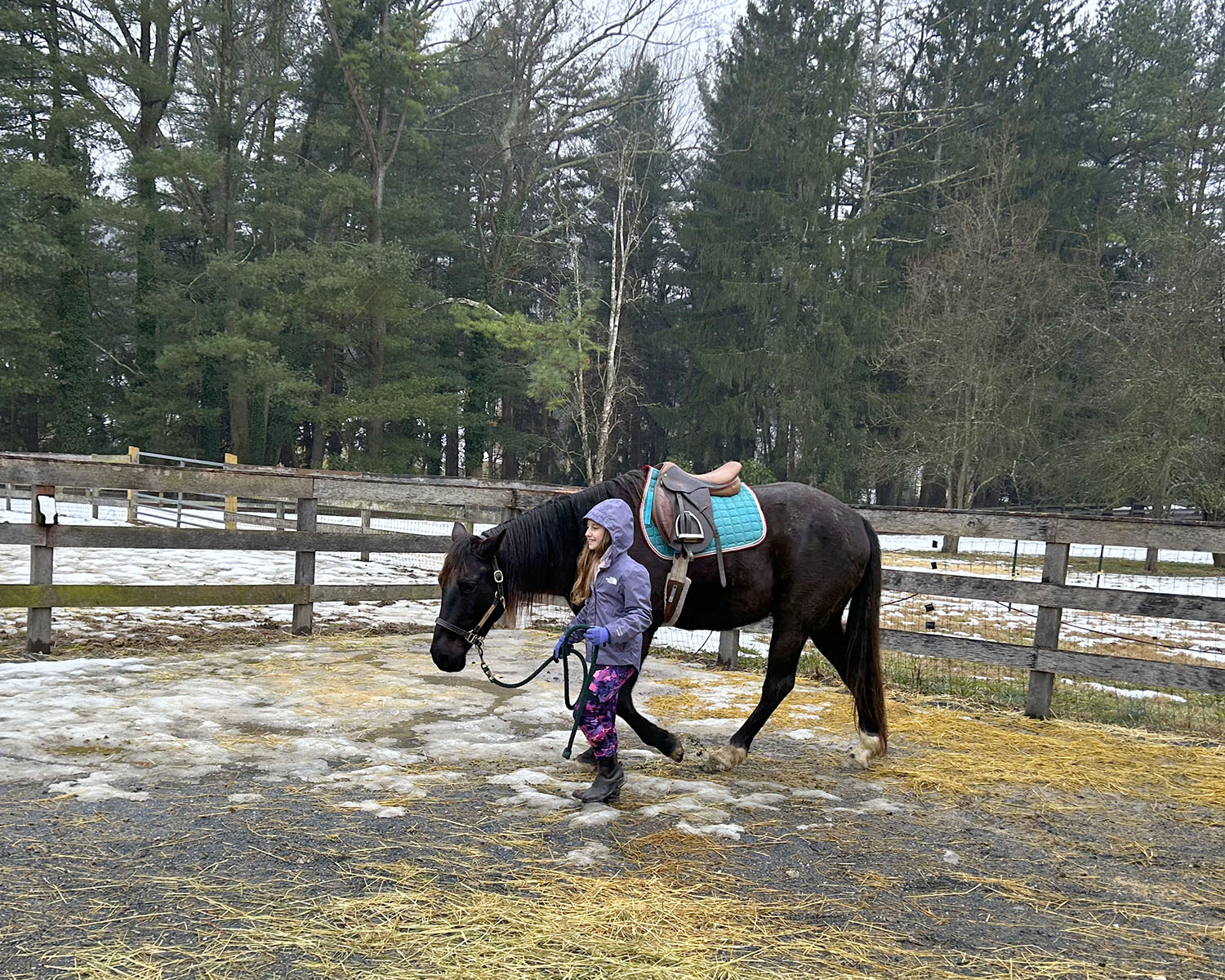
Everything starts at liberty – just being free around each other, and focusing on building a relationship. There is play, there is sharing of thoughts and feelings, and there is curiosity and there is mystery. Learning how to just be around each other comfortably is a benefit for the nervous systems of both horse and human. Social animals feel good about making friends. The first time Kate invited Juno to follow her on a walk around the paddock, the weather was miserable, but the feelings were of pure comfort and joy in connection, as he eagerly walked alongside her and she beamed with excitement.

Sometimes we have fun with inventing new activities or games… like asking the horse to carry her jacket around the paddock. Every step of the way, Kate is attentive to how Juno is feeling about what is being asked of him. She never rushes him for the sake of accomplishing a task, and has been learning to recognize when and how impatience and frustration can sneak up on us and get in our way.
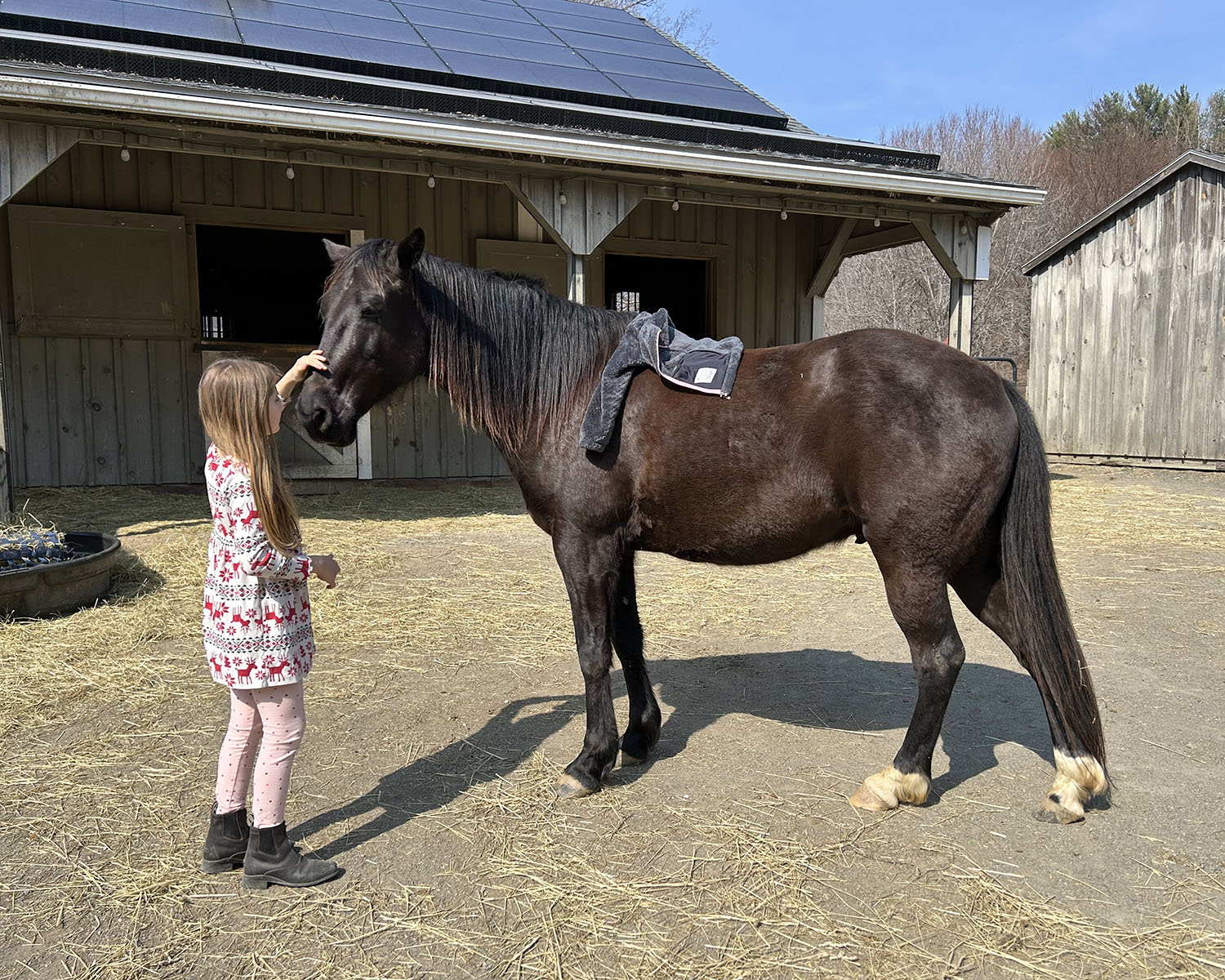
When the goal is for the horse to be comfortable and happy, every small step can be a resounding victory. At first, when Kate introduced the halter and lead rope into our activities together, Juno was inclined to shake his head a lot and walk too quickly for her to stay next to him, especially when something was introduced for him to carry on his back. We explored what being asked for too much too quickly feels like for us as people, too. We came up with options, like taking a break and doing something fun or easy together for a while and then trying the more challenging thing again in a different way.

When Kate walked Juno around the paddock with his saddle on and he was finally relaxed and enjoying the walk as much as the ones they had done together at liberty, it was the look on Kate’s face that said it all: she was happy, comfortable and proud of herself and the horse.
The day that Kate’s mother told me that she was having a hard time when other girls her age taking riding lessons were asking her questions like, “Can you canter?” and “Have you jumped yet?” filled me with sadness. What this girl is learning with a horse is genuine relationship, sensitivity to his feelings and her own, and a solid foundation for anything she may want to do in the future, with or without horses. It’s hard to quantify depth as opposed to scope of accomplishments. I hope she can respond with, “Do you take walks with your horse with an invisible lead rope?” and “Have you helped a worried horse feel safe in a new home yet?”

When Kate does get on the horse, she spends time with Juno on the ground first, making sure they are both comfortable. She talks to him – about how she is feeling and how she hopes he will feel if she rides him. If he tosses his head or pulls away, she knows how to listen, to care, to patiently try a different approach. She knows how to check in with her own feelings and determine whether she is ready or if she needs to take a break and reset.

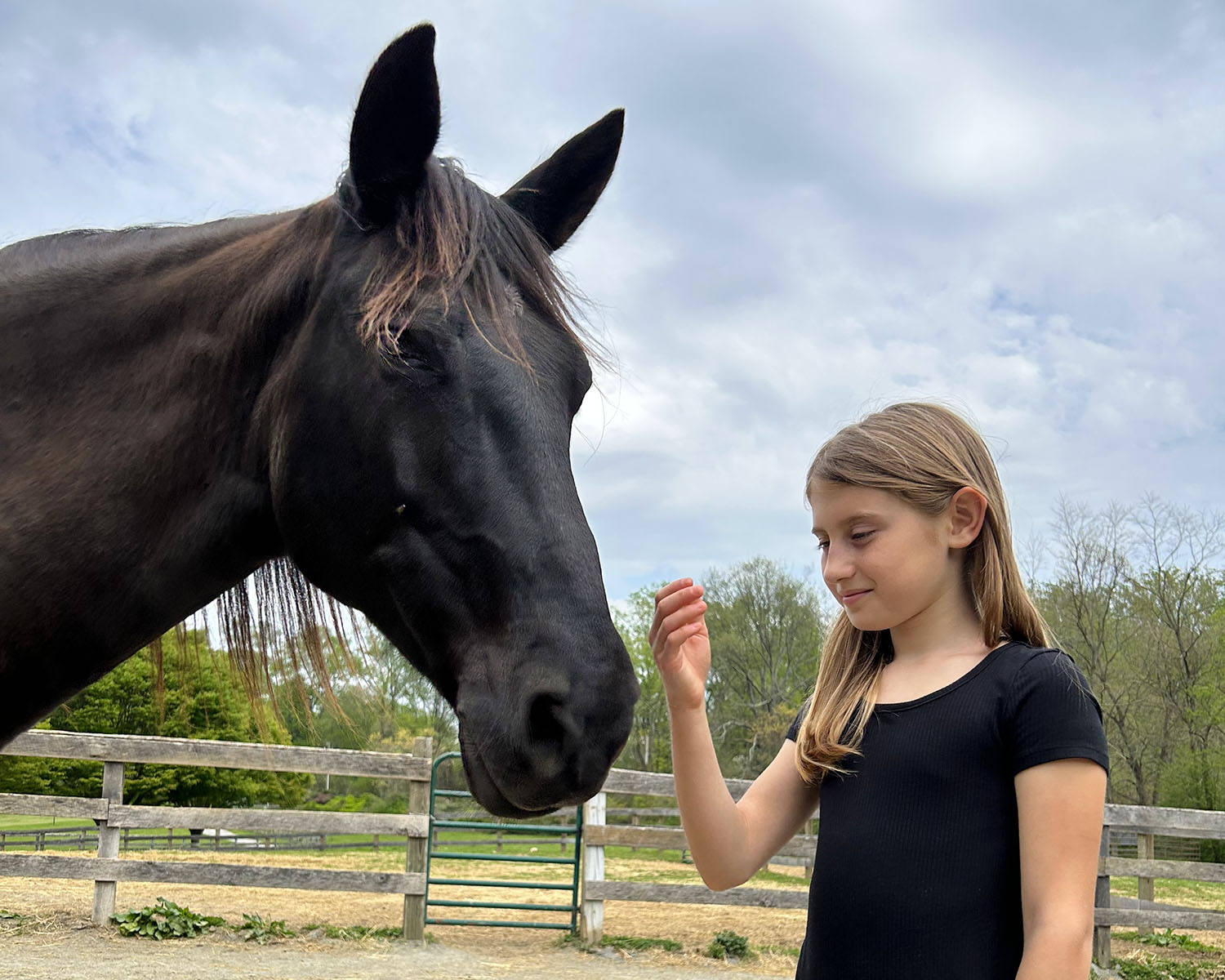
The kindness and the trust these two are sharing is beautiful. He sees her arrive and hangs his head over the gate in anticipation of a friend. She is always happy to see him, and it is in the being together, not the doing together, that she is finding joy.
Beyond Words

My first vinyl collection was a beloved assortment of stories, handed down from older cousins, uncles and maybe even my mother. The records were well-loved with a few skips and scratches by the time they came to me. Among the favorites were Dr. Dolittle, The Jungle Book, and Ferdinand the Bull. It’s no wonder that I grew up understanding that animals were friends and allies, with hearts and minds and voices of their own. I had conversations with dogs and chickens and horses on the regular, as they were all very good listeners, and quite capable of making me feel better on a bad day and not-so-alone any time.

Somewhere along the line of growing up, I lost faith that I could really understand them. I wasn’t entirely sure they could understand me any more either; maybe they could pick up some basic or obvious sentiments, but I began to doubt the level of communication I had once believed in devoutly. The record collection shifted… folk and rock music began shaping the way I related to being human, focusing on lyrics and words and how they resonate with people.

It has taken one very persistent horse to reconnect me with believing in different ways of communicating again. Daisy joined me fourteen years ago, as I set out to learn and practice and explore the field of Equine Guided Education and Coaching. She and I have always made valiant efforts to speak to each other – sometimes her frustration at my lack of understanding resulting in her boycotting everything I ask of her until I finally “get it.”

In general, we have a decent level of understanding one another, which I would expect from being together through three states, nine different farms of residence, five different equine family members, and hundreds of people of all ages coming to sessions. What I did not expect was the way she is able to clearly communicate with people she has just met.

The first time I remember Daisy taking the lead in a client session was about seven years ago. She was often overshadowed by my elder mare, Taj, who held a commanding presence and was rarely subtle, so it was easy to follow her lead. I, myself, thought of Daisy as the young, friendly ambassador who was able to disarm people who had resistance and tended to make everyone feel welcome. It was in the round pen with an independent-minded woman with whom my co-facilitator and I were working hard to find a way to connect that Daisy took over. Ignoring the ample green grass, the mare stood stock still next to her, appearing to go inward in a reflective, self-focused, resting stance. Neither of them moved, the woman assuming a similar pose, and to any onlooker, it might have appeared that nothing was happening.

As the minutes ticked by, it was at first a challenge to be patient and allow the ongoing silence and stillness. After a while, it became easier to stand and observe, and clearer that something was, indeed, happening between the woman and the horse. After what must have been at least twenty minutes, Daisy finally began moving her lips, licking and chewing and shifting her weight, eventually moving from that spot towards us onlookers on the outside of the pen. The woman thanked her and came over to explain her experience; Daisy had taken her through a range of thoughts and emotions, had helped her cut through to the core of her angst and indecision, and to recognize the next steps she wanted to take in her life.

For some time, I attributed the experience to the woman finding a way to quiet her mind enough to process her own issues and recognize her intuitive guidance. Fundamentally, I was trained to ground my reflections, insights and thoughts in observations of the horse’s and the person’s behavior and body language, and most sessions were heavily focused on movement, interpretation and helping people uncover their own relevance to what transpired. So what kind of grounding was there in someone reporting that one of the horses just told them some things they needed to hear?

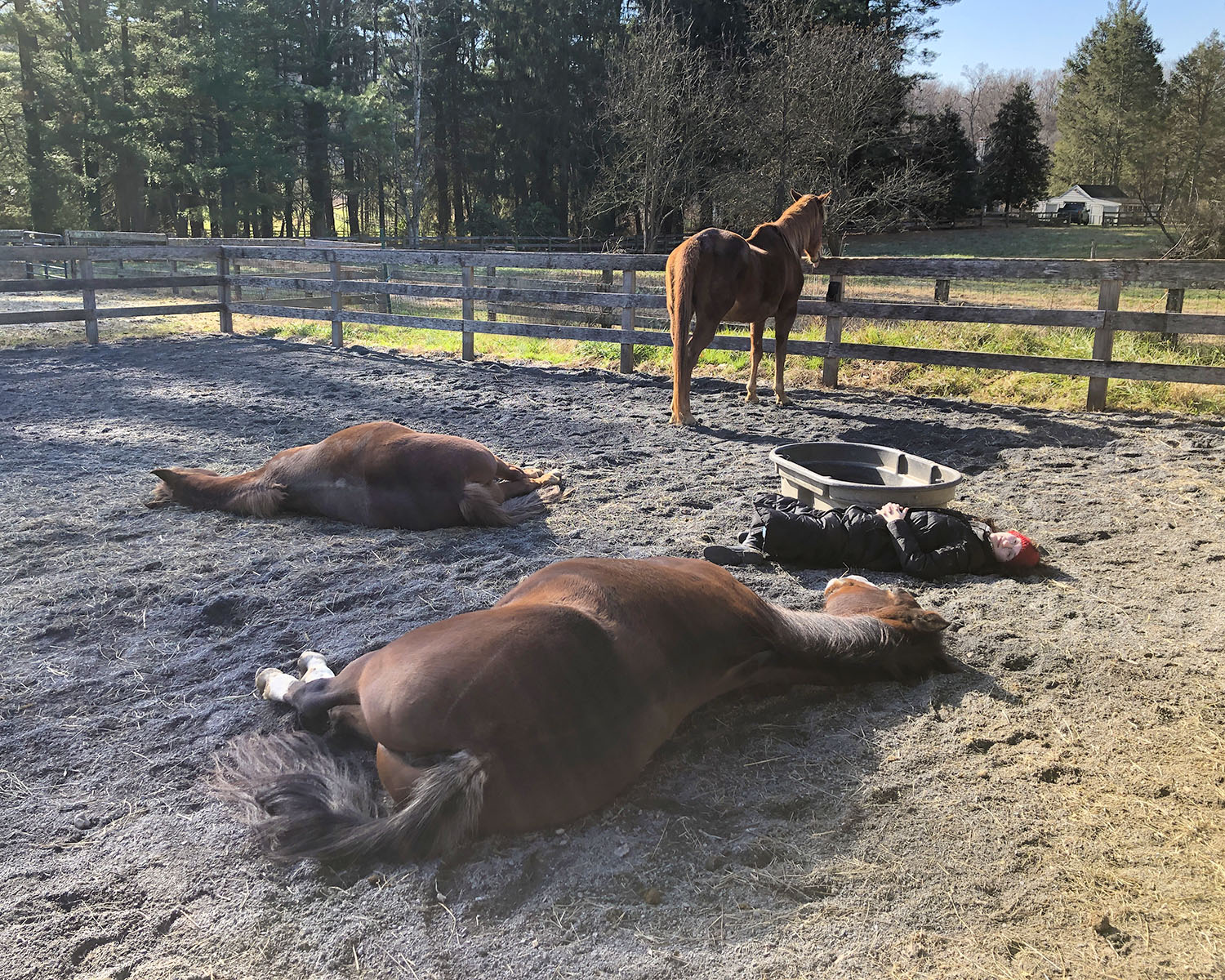
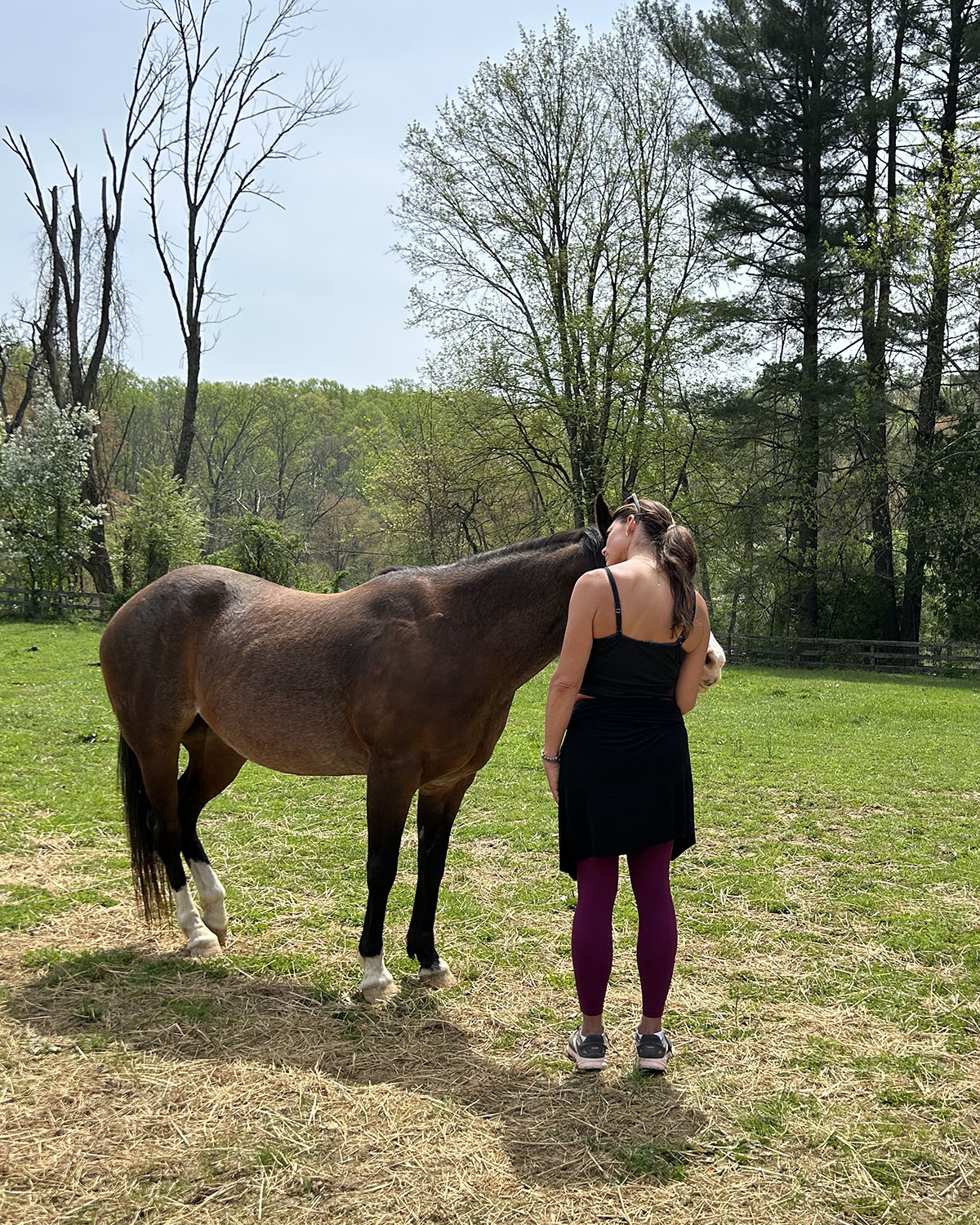
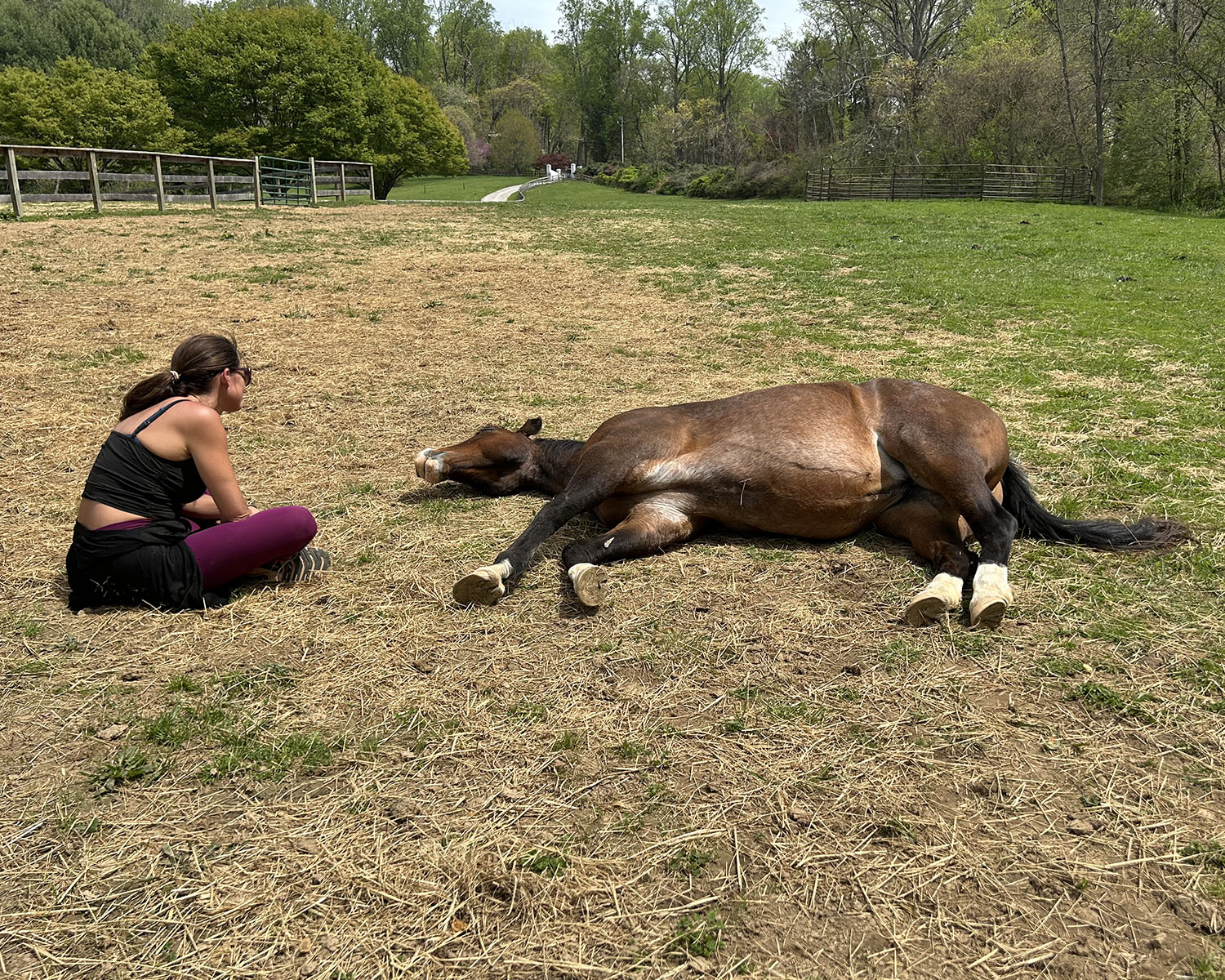
Through the years, I noticed that Daisy would often volunteer more interaction with people than just welcoming them upon arrival. She would find ways to get their attention and work to help them stay present. One method she finds particularly successful is to lie down next to them. Sometimes she will roll, rise up and shake off, sometimes she will relax into a sleep state, and sometimes she will stretch flat out into REM sleep and dreaming. Daisy’s act of communicating through lying down has been contagious. Not only have many people been moved to be on the ground with her, but the other horses have begun to do the same thing with more precise timing.

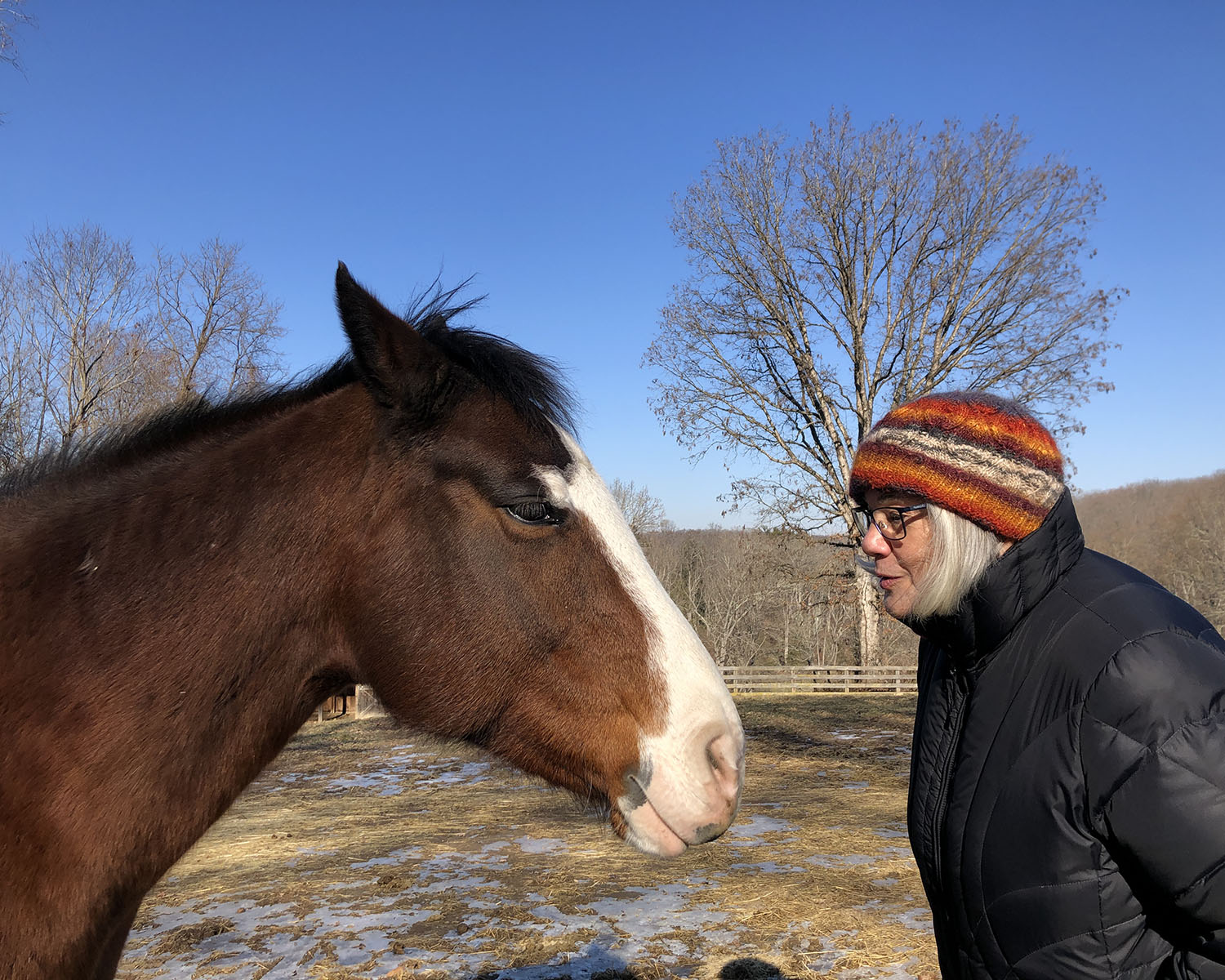
People have reported feeling strong waves of emotion, immense gratitude, specific visual images, and sometimes entire messages that felt like direct conversation from them. The horses do not have to be lying down for this to happen, but sometimes it seems to be how they find “a way in” with people. Let me be very transparent here… I am extremely skeptical of most people with the title “Animal Communicator.” I have had some unfortunate experiences involving self-professed animal communicators with the horses. What I am witnessing here feels like a different way of sharing feelings and insight. Perhaps it is simply that the horses are creating time and space for people to relax enough to feel their own inner knowing with more clarity. Perhaps it is a non-verbal way to communicate that is beyond body language. Perhaps it is a combination of both.

What I can ground in observation is that more relaxation and more sleep results in healthier horses and healthier people. In addition, the profound experience of a horse choosing to stand with, or lie down with a person creates a remarkable space of openness to trust and connection to the thoughts and feelings that arise. There is something fertile in the space of allowing thoughts and feelings to arise without striving for the “right words” right away. If and when we need the words, they will come.