
 by
by There has been a lack of words, a lack of writing in my life these last couple of years. I am starting to find words again, as the horses seem to be speaking up – in their own, nonverbal way. Is it just me? Have I rounded some corner in my relationship with them? Or is the way they are speaking up with everyone who comes to work with them shifting? Perhaps, a little of each. Perhaps, I have learned how to listen better, and perhaps they have learned to trust more that we humans are listening.
***
The morning sun was finally out in full force. Chickens were busy bustling around the paddock, looking for goodies in fresh manure. The sounds of Saturday echoed around us through the trees, with a tractor humming and clanking, a chainsaw in the distance, people making the most of weekend work outside in the country.
Here in the paddock with the horses, nine-year-old Elizabeth was learning how to talk to horses. She was focused on her effort to befriend Daisy, a quarter horse mare who happens to be the most seasoned equine guided coaching horse in the group. Daisy seemed very content to stand quietly alone in the field, unfazed by the surrounding noise and activity. Elizabeth, in turn, was unfazed by the din, and was exploring how to silently speak to the horse with her movements, and let her know she wanted to spend time together. How close could she could walk toward Daisy before Daisy turned even an ear towards her, acknowledging her approach? Several yards away, Daisy swung her whole head towards the girl, who immediately stopped in her tracks in order to show the horse clearly she was paying attention.
Elizabeth continued, very focused, very patiently… when Daisy looked forward again, she would walk carefully toward her, until she swung her head around again, as if to ask, “what do you want?” On the third approach, Elizabeth was no more than 2 or 3 feet from the mare, and she diligently stopped when Daisy turned toward her again. She stood still, waiting for the horse to look forward again.
Instead of looking forward, refocusing on the environment in the distance, Daisy sighed and lowered her head. Then she picked up one hind foot after the other, folded herself in on her front knees, and dropped to the ground at Elizabeth’s feet. The girl was stunned and thrilled all at once. I asked what she felt in her body that she wanted to do, and she said, “I want to get down on the ground with her.”
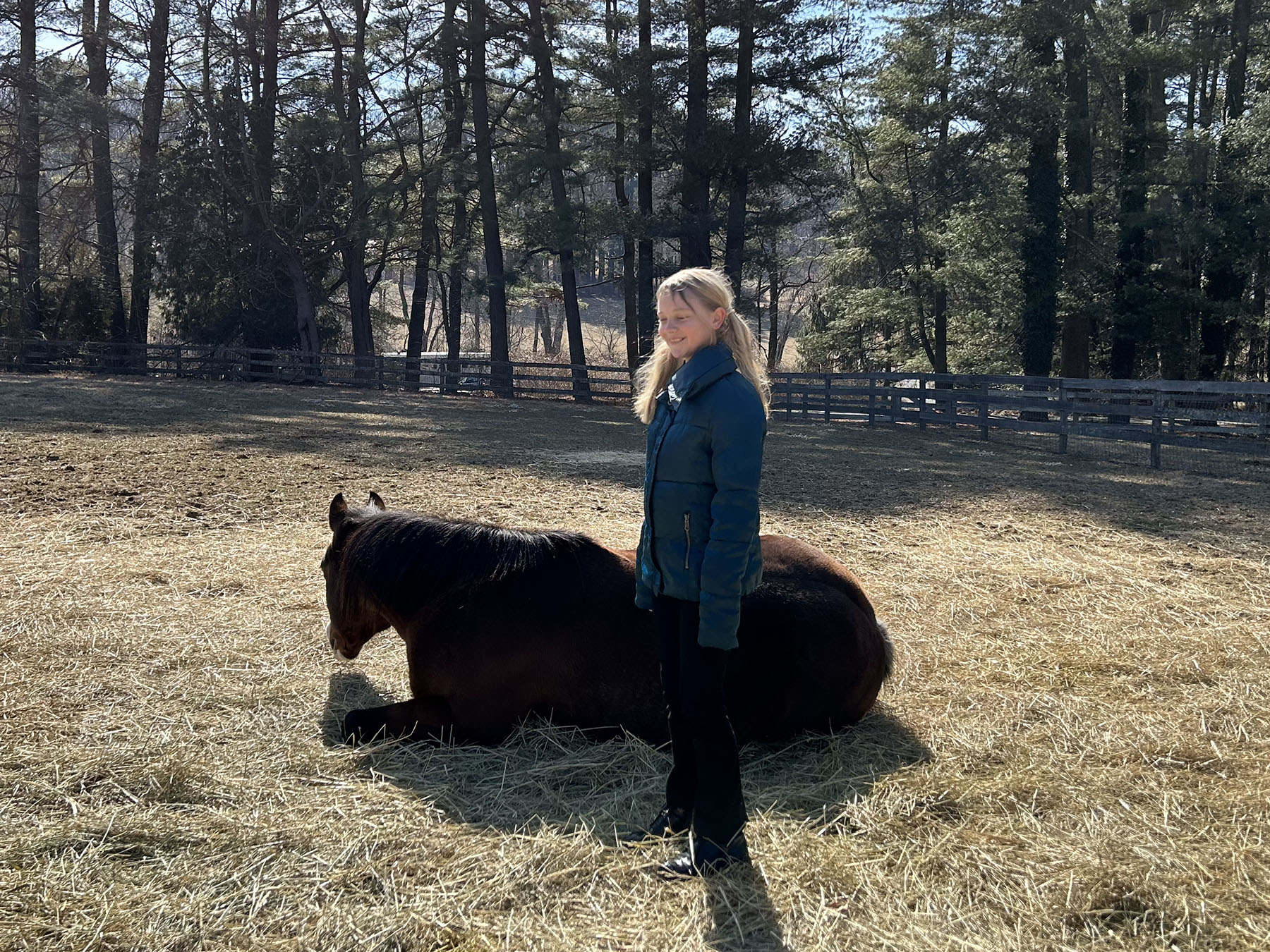
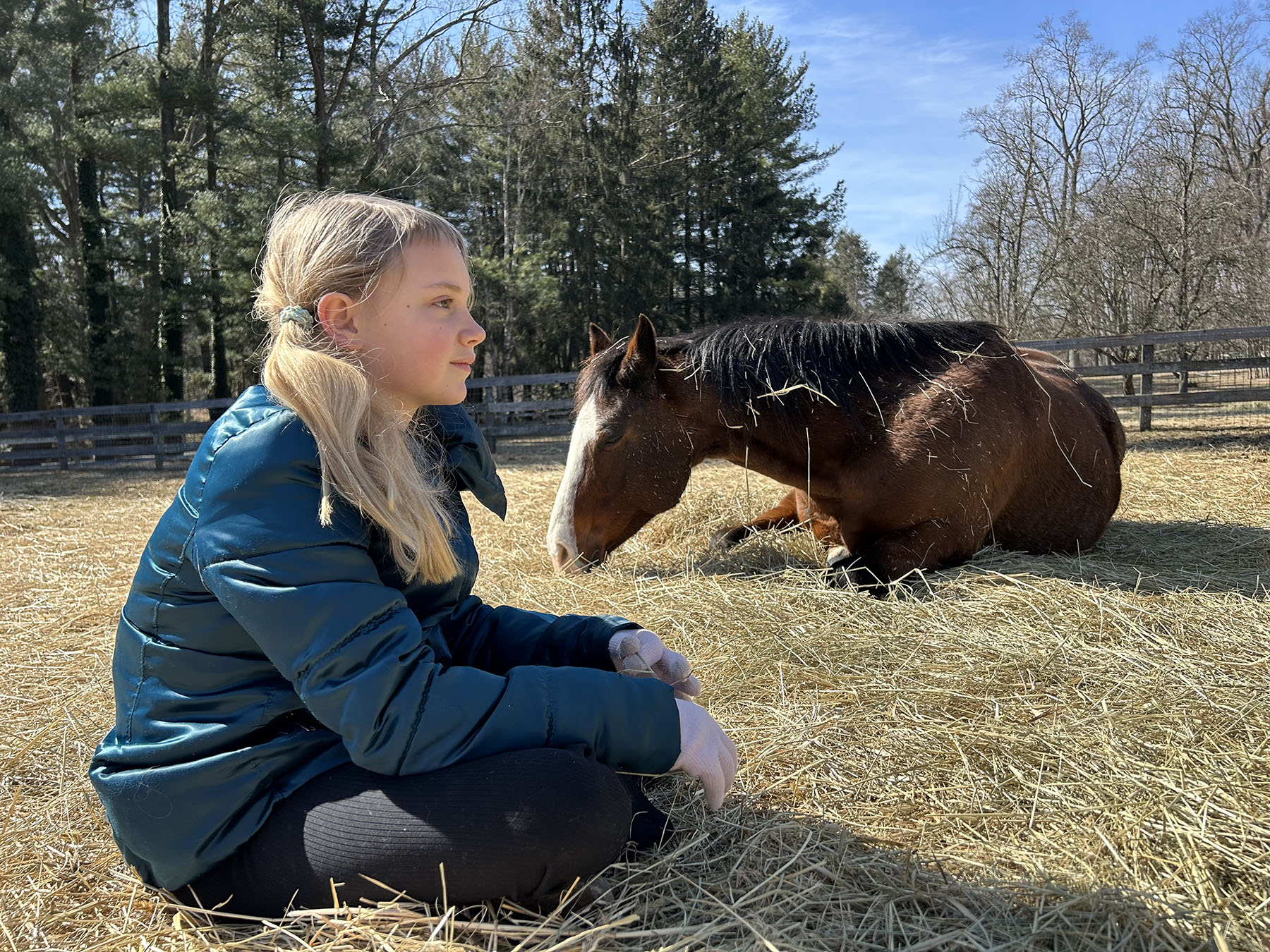
A girl who about twenty minutes prior had said she had trouble standing still was now sitting on the ground with Daisy, quietly and easily tuning in to this moment they were sharing. Her attention focused on feeling the sense of togetherness with a horse, she was fully present, open to the entirety of the experience, and connected to herself and this horse in a new way.
Meditation, mindfulness, present moment awareness… these practices can take a lot of effort, trying and trying again, to even feel slightly successful. Yet a horse can help someone take leaps and bounds in, literally, one sitting.
I used to think that I had to make children’s sessions different from adults because they tend to have much shorter attention spans and I thought they might get bored easily. Here was Daisy, proving me wrong. I’ve since begun treating youth equine guided sessions very much the same as sessions for adults. The horses will meet them where they are, and find ways to help them learn whatever seems to need to be addressed in the moment.
I used to think that Daisy was tired of children, because after years of being the star children’s horse in sessions, she started to head for the far end of the field when she saw a child approaching. Now I realize, she was tired of not being able to do the work she knows how to do with them, as I was teaching primarily fundamentals of care and groundwork and very basic riding. Guess who was getting bored easily.
 Horses for the Soul